The 5 Sales Videos Every B2B Team Should Have Ready
One video can't do everything for your sales team.
Think about it. The video you send to introduce your product to a new prospect probably isn't the same one you'd share with a decision-maker who wants to understand pricing, integrations, or specific features.
And our research reflects that.
In our November 2026 B2B sales video survey, featured in our article Video Is the Future of Sales. So What's Holding Teams Back? , 74% of qualified respondents said their teams use quick salesperson recordings, making them the most common format. Recorded product demos (64%), explainer videos (54%), customer stories (48%), and prospect-specific videos (42%) were also widely used.
But why do sales teams need so many different formats?
A 2024 study by Koponen and colleagues, involving 31 B2B salespeople and eight customers, found that visuals such as simulations, technical drawings, and 3D models can help explain complex products during video-based sales interactions.
However, the researchers also emphasized that human interaction remains important for building customer relationships.
The takeaway? Sales videos aren't there to replace conversations. They're there to make those conversations more useful.
Whether you're introducing a solution, demonstrating functionality, or helping stakeholders make a purchasing decision, the right video can give buyers the information they need at that particular moment.
Five Essential B2B Sales Videos and When to Use Them
Quick Salesperson Recordings
Sometimes, the most effective sales video is simply someone talking to the camera.
Quick salesperson recordings are short, informal videos that sales reps can create to introduce themselves, reach out to prospects, answer questions, or follow up after a meeting.
Unlike professionally produced explainers or product demos, these videos don't require elaborate editing or animation. A simple webcam recording or screen share can be enough to make the message feel more personal.
And they're already a popular choice among sales teams.
According to Motion The Agency's November 2026 B2B sales video survey, 74% of qualified respondents said their teams use quick salesperson recordings, making them the most widely used video format.
These videos are particularly useful during initial outreach and follow-ups, where hearing directly from a real person can help establish a connection.
When to use them: Cold outreach, personalized introductions, meeting recaps, and answering prospect-specific questions.
Explainer Videos
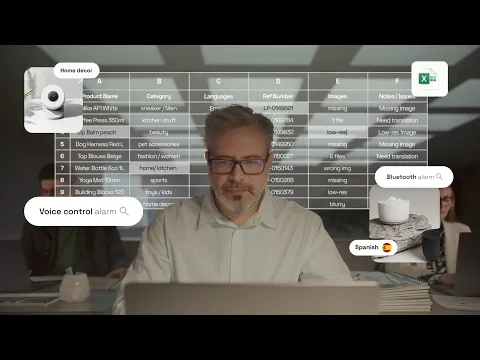
Ever tried explaining a complicated product to someone who's never heard of it before?
That's where explainer videos come in.
Rather than overwhelming prospects with technical jargon or a long list of features, explainer videos break down what your product does, which problems it solves, and why buyers should care.
They typically combine animation, visual storytelling, and clear messaging to make complex ideas easier to understand. This makes them particularly useful for B2B SaaS companies or businesses offering technical solutions that aren't easy to explain through text alone.
And our survey findings reflect their popularity.
In Motion The Agency's November 2026 B2B sales video survey, 54% of qualified respondents said their teams use explainer videos, making them one of the most commonly used formats.
Explainer videos are particularly valuable when prospects are unfamiliar with your solution and need to understand its benefits before exploring individual features.
When to use them: Initial product introductions, early-stage sales conversations, and explaining complex solutions to new prospects.
Recorded Product Demos
Sometimes, prospects don't just want to hear what your product can do. They want to see it in action.
Recorded product demos walk buyers through features, workflows, and functionality, helping them understand how a solution works without needing a live demonstration. They're also easy to revisit or share with decision-makers who couldn't attend a meeting.
And they're widely used. Our November 2026 B2B sales video survey found that 64% of qualified respondents use recorded product demos, making them the second most common video format.
Take the Planful video above as an example. Shared through its quarterly customer newsletter, it demonstrates new features while helping the sales team support customer retention, upselling, and cross-selling.
One survey respondent explained how a recorded demo helped move a deal forward:
"Video is especially helpful during the evaluation stage. A recorded product demo allowed a prospective client to see how the solution worked and how it could address their specific needs. They shared the video with other decision-makers, which helped answer questions, build confidence, and move the conversation forward without scheduling another meeting." — Survey respondent #38, Motion The Agency's 2026 B2B Sales Video Survey.
When to use them: Product evaluations, post-demo follow-ups, feature updates, and customer expansion conversations.
Customer Story Videos
Your sales team can talk about how great your product is, but hearing it from an actual customer? That's a different story.
Customer story videos show how businesses use your product to solve real problems and the results they've achieved. They're especially useful for building trust, giving sales teams credible proof to share during pitches and purchasing decisions.
Our November 2026 B2B sales video survey found that 48% of qualified respondents use customer story videos.
Take Mirakl's customer story video above as an example. Mirakl understands the value of letting customers tell their own stories. And while good visuals help keep viewers engaged, what really matters is the narrative: the customer's challenges, their experience with the solution, and the results they achieved.
A compelling customer story gives prospects something more convincing than a sales pitch: a real example they can relate to.
When to use them: Sales pitches, proposal follow-ups, product evaluations, and late-stage conversations where buyers need reassurance before committing.
Prospect-Specific Videos
Personalized sales videos don't always look the same. For one prospect, it might be a quick screen recording explaining a specific feature. For another, it could be a video from an event that addresses their interests or challenges.
What matters is how relevant the content is to the buyer.
These videos help sales teams address specific questions, demonstrate workflows, or tackle purchasing concerns without relying on generic sales materials.
Our November 2026 B2B sales video survey found that 42% of qualified respondents use prospect-specific videos.
One respondent shared how a personalized video helped move a deal forward:
"During the late stage evaluation phase, we sent a personalized Loom screen recording walking through specific dashboard workflows tailored to the prospect's integration requirements. The champion shared it directly with their CTO and finance lead, which cleared technical blockers faster and helped us accelerate contract approval by two weeks." — Respondent, Motion The Agency's 2026 B2B Sales Video Survey.
The takeaway? Personalization isn't necessarily about putting someone's name in a video. It's about giving prospects information that directly addresses their needs.
When to use them: Personalized outreach, technical evaluations, stakeholder follow-ups, and late-stage sales conversations.
Prospect-Specific Videos
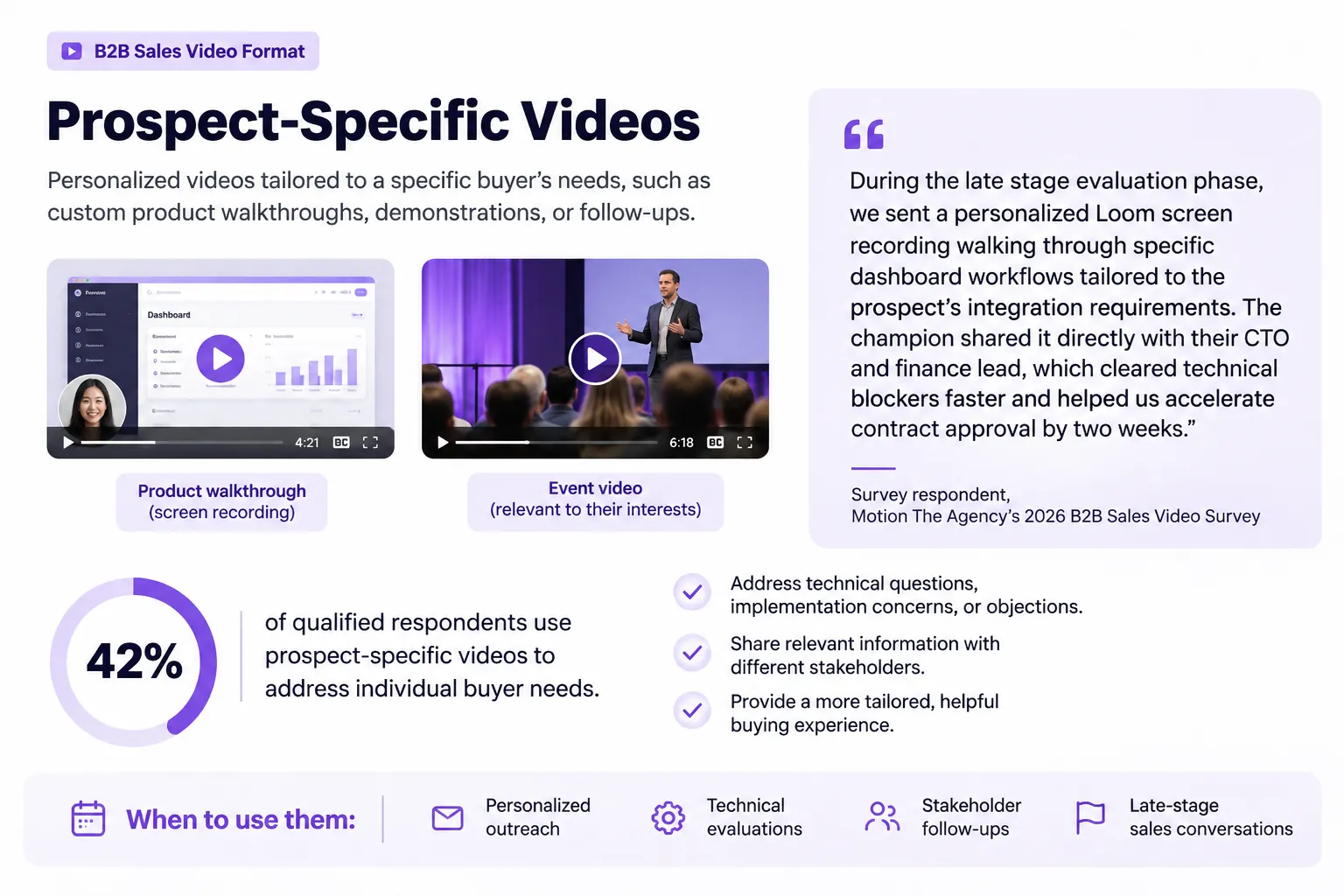
Personalized sales videos don't always look the same. For one prospect, it might be a screen recording explaining a specific feature. For another, it could be a recording from an event that addresses their interests or challenges.
What matters is how relevant the content is to the buyer.
These videos help sales teams answer technical questions, address purchasing concerns, and provide information tailored to different stakeholders.
Our November 2026 B2B sales video survey found that 42% of qualified respondents use prospect-specific videos.
One respondent shared how a personalized recording helped move a deal forward:
"During the late stage evaluation phase, we sent a personalized Loom screen recording walking through specific dashboard workflows tailored to the prospect's integration requirements. The champion shared it directly with their CTO and finance lead, which cleared technical blockers faster and helped us accelerate contract approval by two weeks." — Survey respondent #6, Motion The Agency's 2026 B2B Sales Video Survey.
The point is that personalization isn't just about adding a prospect's name to a video. It's about addressing their specific needs and giving them information that helps move the conversation forward.
When to use them: Personalized outreach, technical evaluations, stakeholder follow-ups, and late-stage sales conversations.
Sales and Buyer Journey
Each of the five video formats we've covered has its own strengths, but knowing when to use them is just as important as knowing what they do.
Depending on where prospects are in their sales journey, certain videos may be more useful than others. That said, treat this as a guide, not a rulebook. Every buyer's journey is different, and we're not suggesting that every prospect needs to follow the same process.
To help illustrate this, we've put together a simple table based on our survey findings and our experience creating personalized videos for clients.
Of course, the buyer journey isn't always linear. A new stakeholder might need an introductory explainer even when the rest of the team is close to deciding. Prospects may also revisit the same video or share it internally at different stages.
That's why sales teams shouldn't feel restricted to a fixed sequence. Instead, focus on what your prospects need to know at that moment and choose the video that best answers their questions.
B2B Sales Video Do's and Don'ts
Not every prospect needs the same video. Someone discovering your product probably doesn't need a 10-minute feature walkthrough, while someone comparing solutions won't get much value from another generic introduction. The best sales videos answer the questions buyers actually have.
And not every video needs a big production budget. A quick screen recording might work for a personalized follow-up, while a polished explainer can simplify more complex ideas.
But personalization shouldn't come at the expense of accuracy. One respondent from our B2B sales video survey shared what happened when sales and marketing weren't aligned:
"Sales didnt run video by marketing, recorded their own and sent wrong information when reaching out to a potential client. Usually the personalised videos are well recieved." —Survey respondent #135, Motion The Agency's 2026 B2B Sales Video Survey. Quote reproduced verbatim.
Survey respondent #135, Motion The Agency's 2026 B2B Sales Video Survey. Quote reproduced verbatim.
That's why sales teams need access to approved messaging, accurate product information, and reusable creative assets. They should have the flexibility to personalize videos without risking inconsistent or outdated information.
Ultimately, sales videos should support conversations, not replace them.
Building a Reusable B2B Sales Content Library
Why Sales Videos Are Difficult to Keep Up to Date
Imagine your sales team is about to send a product demo to a promising prospect, only to realize the video shows an outdated interface or features that have already changed.
For SaaS companies, this happens more easily than you'd think. Products evolve constantly, and sales teams need videos that reflect the latest features, different buyer roles, industries, and use cases.
Sounds like a simple edit, right? Not always.
Updating one product screen might also mean adjusting the animation, rerecording the voiceover, and reworking the timing. When that scene appears in multiple video versions, the work adds up quickly.
And the consequences go beyond production delays. Sales reps might share inaccurate information, rely on generic videos that don't address a prospect's needs, or wait for updated content while a deal is moving forward.
That's why having a reusable asset library is essential. By keeping approved UI mockups, illustrations, animations, and other creative elements in one place, teams can update and adapt videos without rebuilding everything from scratch.
Our work with ClickUp is a good example of how this works in practice. We've supported their ongoing content production, from full explainer videos to short animations and GIFs for customer newsletters. Rather than creating every visual from scratch, we reuse and adapt existing illustrations, UI assets, and animations for new content needs. This helps maintain brand consistency while making it easier to produce different formats.
While ClickUp's example covers broader marketing and customer communication, the same approach applies to sales enablement. A reusable asset library gives teams a foundation for creating updated demos, personalized versions, and supporting content as product messaging evolves.
Ultimately, it's about helping sales teams get accurate, relevant content into buyers' hands when they need it most.
What a Reusable Sales Content Library Should Include
Having a collection of sales videos is a good start. But if your team can't find the right video when a prospect needs it, or update it when your product changes, how useful is that library?
Our November 2026 B2B sales video survey found that 91% of respondents had a centralized video library, yet 31% said theirs was difficult to search or outdated.
A useful sales content library needs more than a folder full of finished videos. It should include:
- Ready-to-use videos: Explainers, product demos, customer stories, and personalized sales content that reps can quickly share with prospects.
- Reusable creative assets: Editable UI mockups, illustrations, motion graphics, and branded templates that make future updates and variations easier.
- Clear organization: Content grouped by buyer questions, sales stages, products, or use cases so sales reps know where to look.
- Version control and ownership: Clear naming conventions, designated owners, and up-to-date versions so outdated messaging doesn't reach prospects.
And here's something worth considering: your finished video library and your editable asset library should work together. Sales reps need approved content they can send immediately, while marketing and creative teams need access to the original assets to make updates without rebuilding everything.
This also makes it easier to repurpose existing videos for different channels, including personalized outreach and follow-up emails. We explore how to use video, GIFs, and AI for this in our guide to B2B video email marketing .
The goal isn't to build the biggest video library. It's to build one your sales team can actually use, with content that's easy to find, accurate, and ready when a buyer needs it.
Beyond One-Off Videos: How Mirakl Built for Scale
ClickUp isn't the only example of how reusable creative assets can support ongoing video production. Our partnership with Mirakl shows how a single project can grow into a much larger creative system.
Mirakl, a global enterprise marketplace SaaS company, initially approached us in late 2025 for a two-minute explainer video. Over the following seven months, that first project grew into six contracts, eight projects, more than 30 videos, and 11 Lottie animations.
And the scope went well beyond explainer videos.
Our team supported product launches, edited customer interviews, created event videos and stage graphics, and developed animations for Mirakl's website. With multiple campaigns and four international events to support, the challenge was producing different types of content under tight deadlines while keeping everything consistent with the brand.
One particularly interesting challenge was creating product visuals before the actual interfaces were ready. Working closely with Mirakl's product team, we designed UI mockups that represented products still in development. These assets could then be reused and adapted across videos, campaigns, and other marketing materials.
We also developed reusable illustrations, motion graphics, and Lottie animations, giving future projects an established visual foundation rather than requiring every asset to be built from scratch.
As Savira our Head of Creative:
"Having an established visual direction and recurring content structure makes the next campaign easier to produce."
And that's what made the partnership work. By building reusable creative assets and coordinating production across multiple team members, we could support Mirakl's growing content requirements without treating every deliverable as a completely separate project.
For B2B sales teams, there's a useful lesson here. A content library shouldn't just store finished videos. It should also give your team the creative building blocks to produce new content, update existing materials, and respond to changing buyer needs.
That's how you move from producing individual videos to building a creative system that can scale alongside your business.
Explore our full Mirakl case study .
Conclusion: Better Sales Videos Start With a Better Content System
Sales teams don't need more videos just for the sake of having them. They need the right videos for the right conversations.
A quick salesperson recording might help start a conversation, while an explainer, product demo, or customer story can help buyers understand your solution and make more informed decisions. The key is knowing what your prospects need and choosing the content that helps them move forward.
But creating those videos is only half the challenge. Keeping them accurate, relevant, and easy to update matters just as much.
As we've seen from our work with ClickUp and Mirakl, building a reusable creative system makes it easier to produce different types of content without starting from scratch every time.
That's where we see the future of B2B sales video heading: not toward more disconnected videos, but toward a connected library of content that sales teams can actually use.
At Motion The Agency , we help B2B brands build that foundation, from individual videos to reusable creative assets that support ongoing sales and marketing needs.

Wira Wibisana
As a Design & Marketing Specialist at Motion The Agency, Wira loves sharing knowledge, trends and crafting content that helps brands grow through video and design.

In just a few questions, get a tailored estimate for your next video project.




Contact Us
Ready to elevate your brand? Contact us for your
Free Custom Video Sample