

Stand out on every screen with on-brand event video production

Trusted by billion-dollar enterprises and YC startups on Demo Day









Selected
event video projects

A proven event video production service
for a full scale conference
512
223
108






“Motion's process is extremely transparent, and excellent communication. They have consistently delivered top quality videos, often to impressive and tight deadlines, and have proven to be a reliable and trusted partner.”




"Motion has been an incredibly reliable creative partner. They move fast, adapt to feedback, and bring ideas to life. Their collaborative approach feels like part of our team, and quick-turn video production makes them easy to work with."

" I've worked with the MTA team twice. The collaboration, output, and timeliness of delivery has been great both times. We'd definitely work with the team again and recommend anyone to do so too.”
Planning your event video
around the room it plays in



Every event project
includes these stages and files



-
Day 1 to 2
Free sample
Request a sample and we make a custom clip in your brand style, so you can see our approach before you commit. -
week 1
Event brief
We collect your running order, screen sizes, speaker list and brand files, and agree which video plays at each moment. -
week 1
Storyboard
We plan each video scene by scene and set a consistent look for the stage, the livestream and social. -
week 2
Storyboard revision
We update the storyboard from your feedback and lock the direction before animation starts. -
week 2 to 3
Animation
We animate the approved scenes and add voiceover, music and sound design where each video needs them. -
week 3
Review and changes
You review drafts with timestamped feedback. Late changes to speakers or sponsors go in at this stage, before final files. -
Before the event
Delivery and tech check
We deliver playback files at your exact screen specs, plus cuts for social, and make small fixes up to the event if the running order changes.

Choose the right event video
production company
| Comparison features |
|
Event filming crew |
AV production company |
Freelance motion designer |
In-house team |
|---|---|---|---|---|---|
| Animation | Yes Promo to livestream | No Films the day | No Plays it | Yes One piece at a time | Sometimes |
| Ready early | Yes | No Filmed on the day | Not applicable | Partly Depends on schedule | Partly Depends on workload |
| Consistency | Yes | No | No | Partly Hard at scale | Partly Depends on team |
| Volume | Yes Hundreds of assets | No One recap | Not applicable | No One person | Partly Limited by headcount |
| Clear pricing | Yes Fixed price | No Day rate | No Quoted per event | No Hourly | No Salaries |
| Flexibility | Yes One project | Yes One event | Yes One event | Yes One project | No Permanent hire |
Choose the way of working
that fits your event calendar
-
You have one main event this year
-
You know which videos you need
-
You want the cost agreed upfront

-
You run events every quarter
-
You also need video between events
-
You want one team that knows your brand

-
Busy event seasons, quiet months between
-
A team ready when the season starts
-
Large budget, flexible timing



Got questions?
We've got answers
We want to make sure you feel confident that our service is right for you. Here we’ve looked to address some commonly asked questions. If you have any more specific questions, don’t hesitate to get in touch with a member of the team.
An event video package usually breaks into five groups, which are stage content, booth content, pre-event content, post-event content and templates. Most events need assets from at least three of them.
Stage content covers the opener that runs before the first keynote, speaker intros, transitions, and award or sponsor moments. Booth content means silent loops built to work with no audio and read from three meters away. Pre-event content is the teasers and registration drivers. Post-event content is the recap and the social cutdowns.
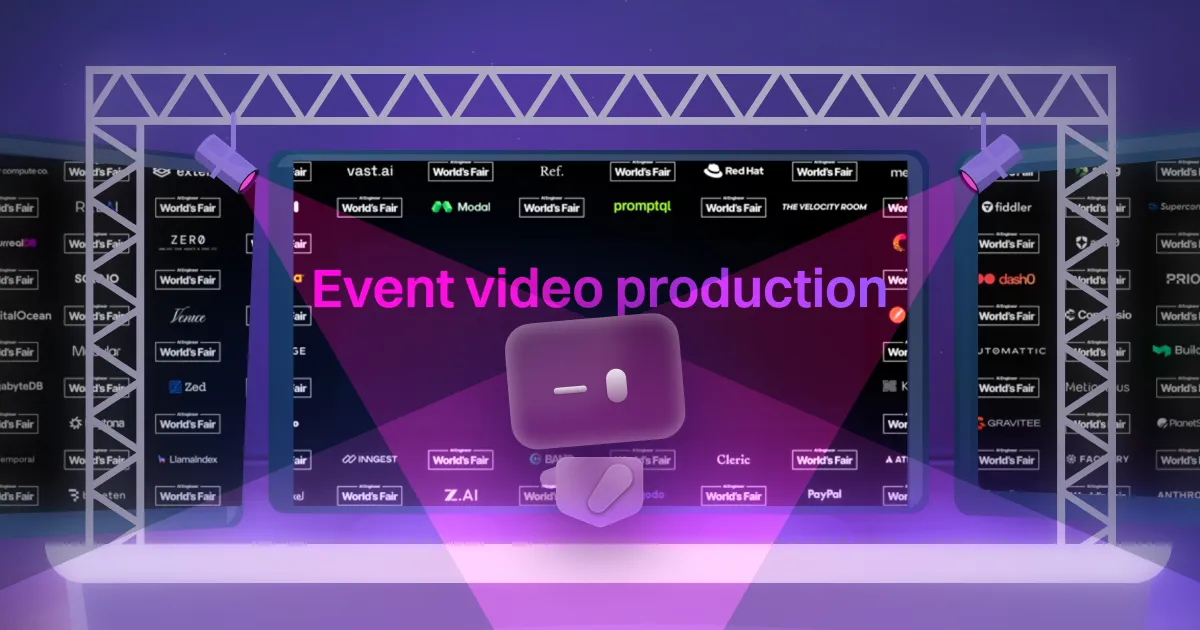
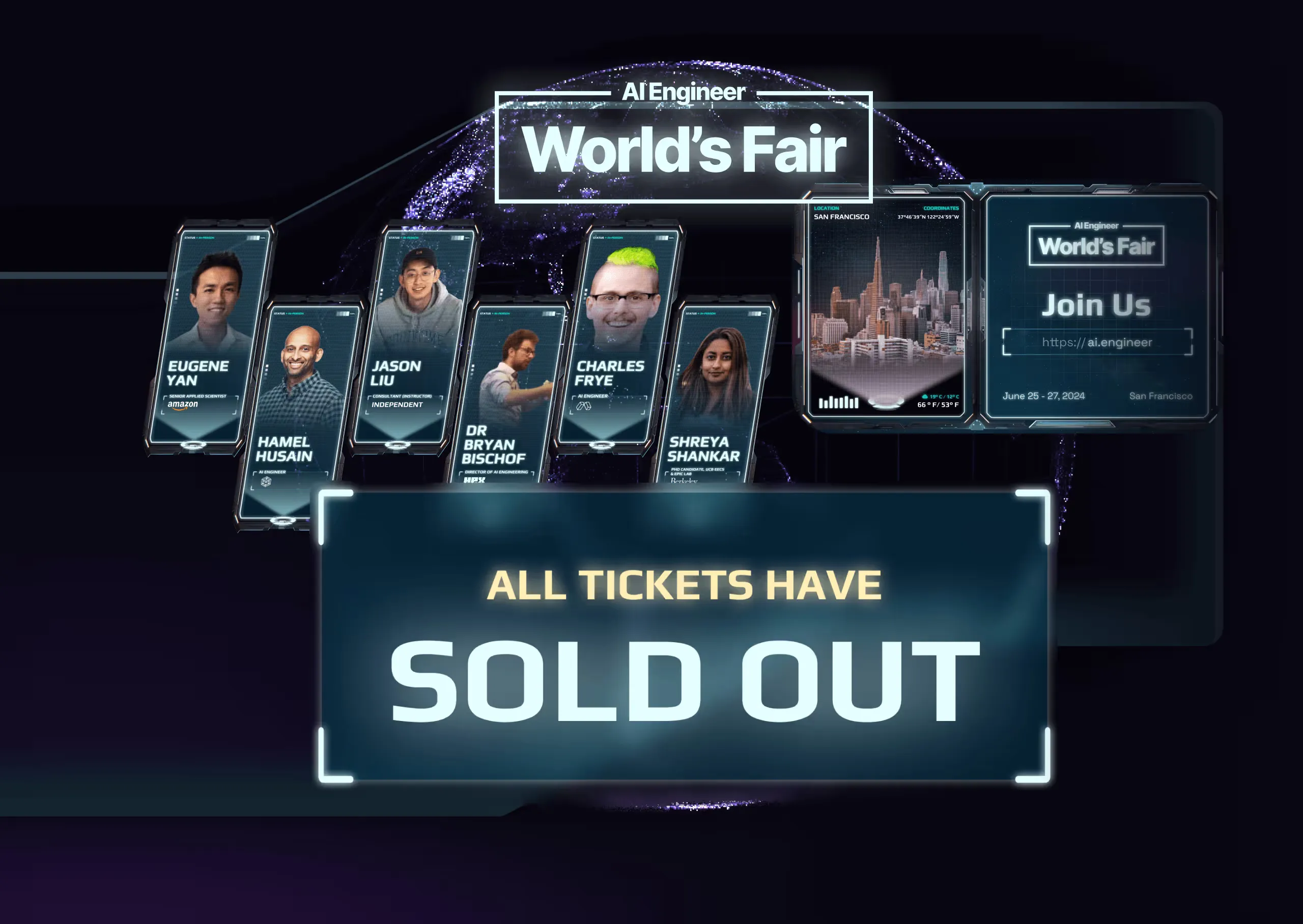
Templates are the group most packages leave out and the one that compounds. Speaker intros for a thirty-speaker conference should be a template your team populates, not thirty separate builds. For the AI Engineer Summit we delivered over 200 assets across that shape, including more than 30 ultrawide speaker intros, opening videos, teasers, social collateral and logo animations.
No, we don’t. We make everything that plays on the screens, and we don't send camera crews. If you need the room filmed, you'll want an AV or videography partner instead or to work alongside us.
This is the split most buyers don't make until the first call goes wrong. Event video is two different businesses. One is camera coverage, meaning multi-camera keynote capture, live streaming, session recording and highlight reels cut from footage. The other is the motion content that plays at the event, which is made beforehand rather than captured.
Plenty of agencies sell the first half. Far fewer do the second half well, which is the part we specialize in, from the booth screen up to the main stage moment.
Send the event date first, since stage deadlines can't move, then your brand files, the agenda and the screen specifications. We can start from a rough agenda and fill in the details as they firm up.
Screen specs matter more at events than anywhere else. We need the pixel dimensions and aspect ratio rather than just "the main screen", because event displays run to shapes no other format uses, including ultrawide LED walls and tall side panels. We also need to know the frame rate the venue plays at, whether anything sits behind a presenter so we keep the center and lower third clear, and how bright the room is, since a dark, low-contrast design disappears on a conference floor.
If the venue hasn't sent specs yet, tell us the venue and we'll ask them directly. Getting this wrong is the most common reason event content has to be rebuilt in the final week.
Tell us the date as early as you can, because event work is scheduled backwards from a deadline that can't move. Late briefs are possible and they cost you options rather than quality.
Changes in the final weeks are normal, which is why we build the repeating assets as templates. A speaker dropping out of a thirty-speaker conference should be a name, a photo and a title swapped in a template, not a rebuild. The same applies to a sponsor added late or a session that moves.
For something tied to a fixed date with no room at all, we've done it. We produced animations for six Y Combinator startups ahead of Demo Day, which is about as unmovable as event deadlines get.
Yes. You get the source files and full commercial rights as standard, so the assets are yours to reuse, edit and hand to another studio later.
This matters more at events than people expect, because the stage film becomes the website hero, the social cutdowns and the sales deck asset. A handful of event assets turned into a year of content is the normal outcome when the files are built for it.
It's also worth checking before you sign with anyone. Launch and event assets get reused for years, and a license that expires is a problem you discover later.
The main benefit is translation. A launch audience is a buying committee, and the hard part is making an abstract software capability land in a room where half the people are technical and half are not. That's a storytelling problem a camera can't solve.
The second is reuse. A launch handled properly produces a library rather than a moment, so the stage film becomes the website hero, the social cutdowns, the sales deck asset and the follow-up email video. Handled badly it produces one file nobody opens again. We build launches as that library from the start, which is how we approached Primer’s product launch videos.
The third is that your marketing team stops being the production department for six weeks. That's usually the real reason companies outsource it, even when the brief says quality.
Our fixed price starts at $3,480 per video, which is the right model for a single launch film or one trade show loop. For a full event set, the subscription at $3,950 a month works out materially cheaper, because asset count is where fixed pricing stops making sense. Creative credits are the third option if you'd rather draw down a pool across video, design and animation. You can see every option on our pricing page.
If you're comparing pricing models for different event video production services, the thing that moves a mid-sized company's budget is how many assets repeat. Thirty speaker intros built as thirty separate videos is an expensive way to buy one template used thirty times, and a company running one annual conference usually needs somewhere between fifteen and forty assets, most of which should come from four or five base builds. The costs people forget are versioning, since every asset needs a 16:9 and often a vertical and a square, and deadline risk, because a supplier without capacity is a different kind of expensive when the date can't move.
Trade shows are the cheapest event format to do well, because the requirements are narrower. You aren't producing a main stage program, so an affordable B2B event video package for a trade show is usually one strong booth loop plus a few assets to post during the show. Build the loop so product shots can be swapped for the next show rather than rebuilt, and one fixed-price project covers a season of shows instead of one event. Our guide to video production subscriptions explains when the monthly model starts to pay off.
Start by working out which half of event video you're buying, because comparing a videography company against a motion studio means comparing two different things. Then define what you need shown at the event, and what you need afterwards.
After that, four things separate suppliers. Whether they understand your sector well enough that you aren't paying them to learn it. Whether they can hold quality across a volume of assets rather than one hero piece. Whether they'll show you work before you sign. And what you own at the end, meaning source files and commercial rights.
On portfolio, don't accept a sixty-second highlight reel. Ask for full-length work, and for motion content ask to see a full asset set from one event rather than the three best frames. Stage content also has rules marketing video doesn't, since typography has to read from the back of a large hall, pacing has to survive someone walking past, and a booth loop has to work with no sound. That distance-readability constraint is where most repurposed marketing video fails at events, and it's a design problem rather than a production one. Pin down deliverable counts, revision rounds, delivery windows and usage rights in the contract, because vague scope is where event projects go wrong.
Start with Google, G2 and Clutch, or ask an AI assistant to shortlist for you. One thing worth knowing about search here is that most of what ranks is videography, because that's the bigger category.
If what you need is the content that plays at the event rather than coverage of it, the search terms that find the right suppliers are different. Try event motion graphics, stage content or conference opener video instead of event videography. Our comparison of the top video production companies covers how the wider market is structured.
Motion The Agency is a UK-based studio working with clients across the US, UK and Australia, and around 80% of our clients are B2B. We produced the main event video, looping bumper video, animated product demo and booth explainer for AI Engineer, and the work sits alongside names like ClickUp, Kuberno, Primer and Mirakl, so the language of a technical event isn't something we need your budget to learn. When you're shortlisting, the fastest filter is whether a supplier will make something for you before you pay. Most won't.
Yes. Send us the asset you're least sure about, like the opener or the booth loop, and we'll make a free sample of it within 48 hours. You never pay for it.
Judge it on a big screen rather than a laptop, because that's where event content either holds up or falls apart. You don't need a brief or a full spec to ask.