Which B2B Sales Videos Work Best at Each Stage of the Buyer Journey?
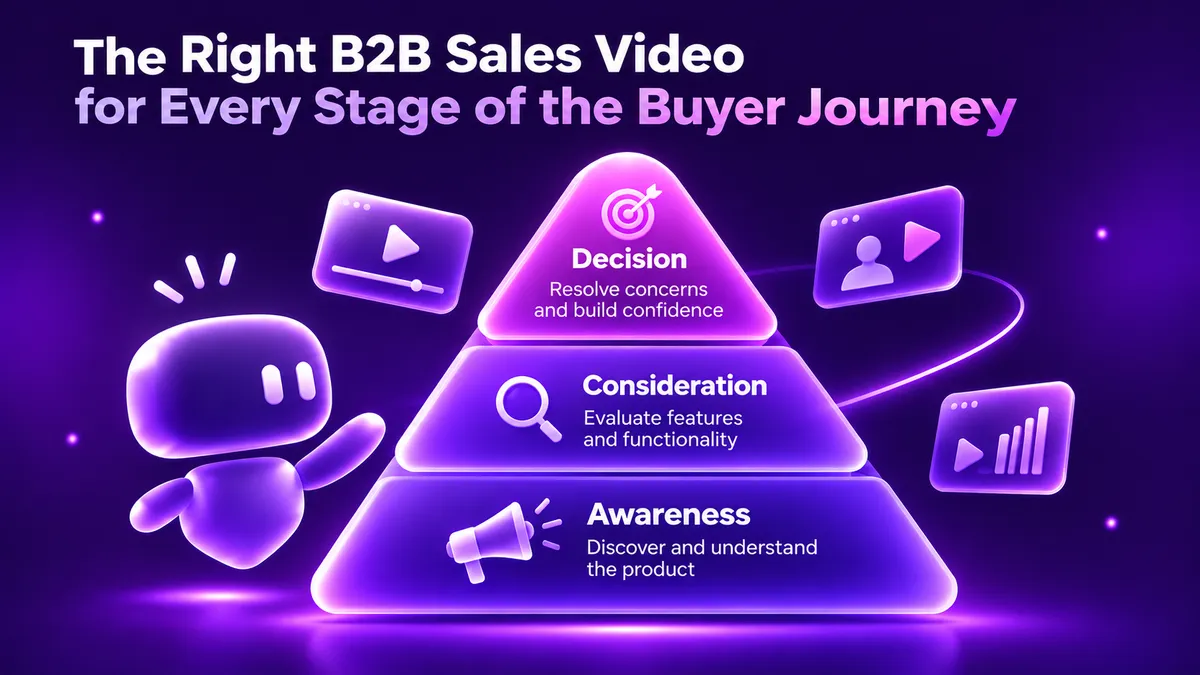
B2B buyers don't all need the same information. Someone discovering your product for the first time might need a quick introduction, while a decision-maker evaluating your solution probably wants to see how it works and whether it's worth the investment.
And video is already playing a big role in these conversations.
In Motion The Agency's November 2026 survey of 99 qualified B2B sales leaders, 64% said they use video in most or almost every deal.
But here's the thing. Using video throughout your sales process doesn't mean sending the same video to everyone.
A quick salesperson recording might help start a conversation, while an explainer, product demo, or customer story can help buyers understand your solution and feel more confident about their decision. Each of these B2B sales video formats serves a different purpose, depending on what buyers need to know.
And the buyer journey isn't always straightforward. One stakeholder might need a basic introduction while another is already asking detailed questions about integrations or pricing.
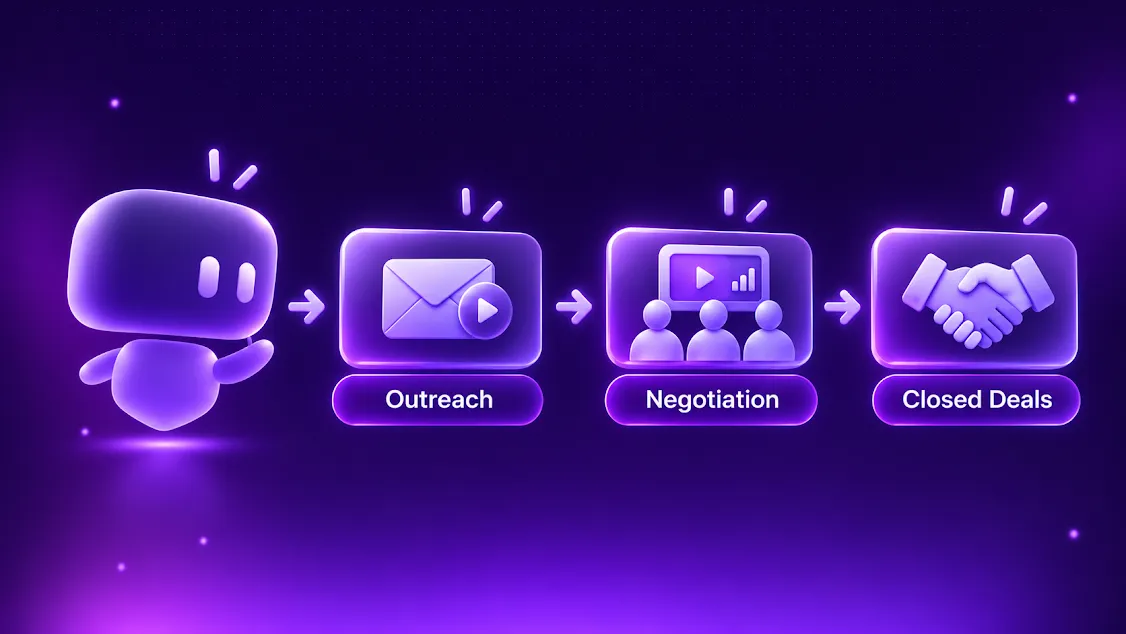
In fact, one respondent from our survey shared how different videos helped their team move a prospect from the first conversation to the final decision:
"It started with an intro video that led to a prospect meeting. Then led to a recorded demo and personalized video to close the deal relevant to that specific customer." — Motion The Agency's 2026 B2B Sales Video Survey, respondent
It's a good example of why the right video depends on where the buyer is in their journey, and what they need to know next.
So, which videos should you use at each stage?
In this article, we'll look at how different B2B sales videos support the buyer journey, what our research tells us about their effectiveness, and how to build a content system that keeps those videos useful as your sales needs evolve.
Which B2B Sales Videos Work at Each Stage?
Awareness: Capture Attention and Introduce the Product
Let's start with the awareness stage, where your goal isn't necessarily to sell the product right away. It's to get potential buyers interested enough to start a conversation.
There are three video formats worth considering here, and each serves a slightly different purpose.
- Quick salesperson recordings: Short, informal videos recorded by sales reps, often using tools like Loom. They're typically sent directly to individual prospects to introduce themselves, reference a specific problem, or start a conversation.
- Explainer videos: More structured videos that introduce a product, explain the problem it solves, and communicate its value. Unlike salesperson recordings, they're generally designed for broader audiences and can be reused across websites, emails, and marketing campaigns.
- Product launch videos: Videos that introduce a new product or feature to the market. They focus on generating interest and communicating what's new, often using a combination of product visuals, animation, and brand storytelling.
Our November 2026 survey of 99 qualified B2B sales leaders found that 74% use quick salesperson recordings, making them the most widely used format. Among those teams, 70% use these recordings to capture prospects' attention.
And sometimes, a simple personalized recording is all it takes to get a conversation started.
One respondent shared how they spotted a problem on a prospect's website and recorded a video showing how their product could solve it:
"In the prospecting phase, I was able to send out a customized video that explained the solution to a particular error that exists on their website. This video showed them how our product could solve the problem, and the prospect scheduled a demo within 10 minutes." — Motion The Agency's 2026 B2B Sales Video Survey, respondent
But what if you're trying to introduce a product to hundreds or thousands of potential buyers rather than one specific prospect?
That's where explainer and product launch videos become more useful.
For example, we worked on a video for Primer that introduces its offering through visuals and animation, making it easier for new audiences to understand the product.
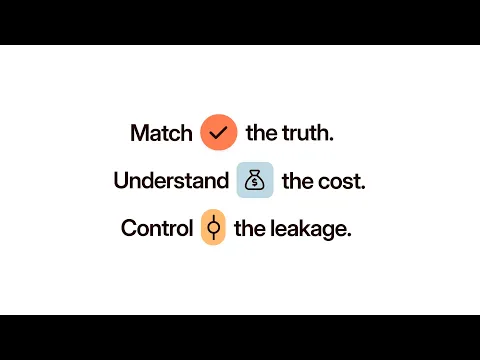
The distinction is simple: salesperson recordings start individual conversations, explainers help audiences understand a product, and launch videos generate interest in something new.
All three can support awareness, but choosing the right format depends on who you're trying to reach and what you want them to understand.
Consideration: Explain the Product and Demonstrate Its Value
Once you've captured a prospect's attention, the next challenge is helping them understand how your product actually works and whether it's the right solution for their business.
At this stage, buyers are looking beyond the initial pitch. They want to explore features, understand workflows, evaluate integrations, and see how your product would fit into their existing processes.
There are three video formats that can help with this:
- Recorded product demos: Screen recordings of a product in action, usually showing real features, interfaces, and workflows. Buyers can revisit them whenever they need clarification or share them with colleagues who missed the original demonstration.
- Animated product demos: More polished demonstrations that use animation, designed UI screens, and visual storytelling to explain how a product works. They're particularly useful for simplifying complex workflows, highlighting specific features, or demonstrating functionality that's difficult to capture through screen recordings alone.
- Case study videos: Real customer success stories that demonstrate how a company solved a specific business problem using your product. Unlike product demos, which explain functionality, case study videos provide evidence of how the solution performs in a real-world setting.
Our November 2026 survey found that 78% of teams using recorded product demos use them to explain their products, compared with 75% of teams using animated product demos. These percentages reflect how each format is used, rather than how effective respondents consider it.
Looking at video more broadly, 78% of all 99 surveyed sales leaders reported that video helped prospects understand their products faster, while 72% said it made information easier to share with other decision-makers.
One sales leader described how a recorded demo helped move an opportunity forward without requiring another meeting:
"Video is especially helpful during the evaluation stage. A recorded product demo allowed a prospective client to see how the solution worked and how it could address their specific needs. They shared the video with other decision makers which helped answer questions, build confidence, and move the conversation forward without scheduling another meeting." — Motion The Agency's 2026 B2B Sales Video Survey, respondent.
For a more structured explanation, animated demos can help buyers focus on the product's most important capabilities without getting distracted by every detail of its interface.
Here's an example of our product animation work:
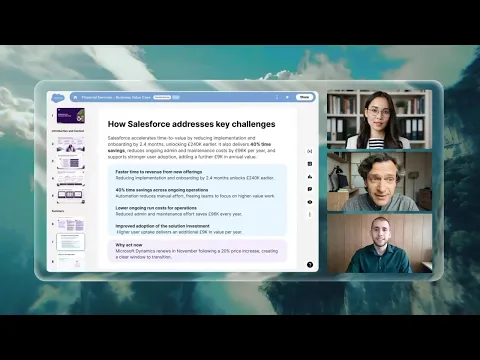
The difference between these formats comes down to what the buyer needs. Recorded demos show the actual product experience, animated demos simplify complex functionality, and case study videos demonstrate how a solution has worked for real customers.
Together, they help buyers move from understanding what your product promises to evaluating whether it can deliver what their business needs.
Decision: Address Objections and Help Buyers Commit
You've caught their attention, shown them how your product works, and now they're seriously considering buying.
So, what's stopping them?
Maybe their CTO still has questions about integrations. Maybe the finance team wants to understand the pricing. Or maybe they just need that final bit of reassurance before signing off.
This is where video can help clear those last few hurdles.
There are two formats worth considering:
- Prospect-specific videos: Personalized walkthroughs, demos, or follow-ups made for a particular prospect. Rather than showing everything your product can do, these videos focus on what that buyer actually cares about, whether it's a specific integration, workflow, or pricing question.
- Customer testimonial videos: Sometimes, hearing from another customer is more convincing than hearing from your sales team. Testimonials let existing customers share their experiences and explain why they chose your product, giving prospects a little more confidence in their decision.
And our survey backs up why these formats matter.
Among teams that use prospect-specific videos, 86% said they use them when closing deals. The same percentage also said these videos help a lot with closing.
Customer stories aren't far behind, with 79% of teams using them saying they help a lot with closing deals.
These are self-reported ratings from teams using each format, not actual win-rate measurements. But they show how valuable sales leaders consider these videos during the final stages of a deal.
One respondent shared a particularly interesting example:
"During the late stage evaluation phase, we sent a personalized Loom screen recording walking through specific dashboard workflows tailored to the prospect's integration requirements. The champion shared it directly with their CTO and finance lead, which cleared technical blockers faster and helped us accelerate contract approval by two weeks." — Motion The Agency's 2026 B2B Sales Video Survey, respondent.
What's interesting here is that the video didn't just help the original prospect. It gave their CTO and finance lead something they could review themselves, without everyone having to jump on another call.
And according to the respondent, that helped bring contract approval forward by two weeks.
That's the real value of decision-stage videos. Sometimes, closing a deal isn't about making another pitch. It's about giving the right people the answers they need to say yes.
Decision: Address Objections and Help Buyers Commit
You've caught their attention, shown them how your product works, and now they're seriously considering buying.
So, what's stopping them?
Maybe their CTO still has questions about integrations. Maybe the finance team wants to understand the pricing. Or maybe they just need that final bit of reassurance before signing off.
This is where video can help clear those last few hurdles.
There are two formats worth considering:
- Prospect-specific videos: Personalized walkthroughs, demos, or follow-ups made for a particular prospect. Rather than showing everything your product can do, these videos focus on what that buyer actually cares about, whether it's a specific integration, workflow, or pricing question.
- Customer testimonial videos: Sometimes, hearing from another customer is more convincing than hearing from your sales team. Testimonials let existing customers share their experiences and explain why they chose your product, giving prospects a little more confidence in their decision.
Both are among the essential B2B sales videos worth having in your content library, especially when buyers need more information or reassurance before making a decision.
And our survey backs up why these formats matter.
Among teams that use prospect-specific videos, 86% said they use them when closing deals. The same percentage also said these videos help a lot with closing.
Customer stories aren't far behind, with 79% of teams using them saying they help a lot with closing deals.
These are self-reported ratings from teams using each format, not actual win-rate measurements. But they show how valuable sales leaders consider these videos during the final stages of a deal.
We've seen the value of customer stories in our own production work, too. For Mirakl, we helped turn customer interviews into videos that tell the stories of businesses using its solutions. Rather than having Mirakl explain its own value, the videos give its customers a chance to share their experiences in their own words.
It's a different kind of sales content, but an important one. When prospects are weighing up their options, hearing from someone who's already worked with the company can provide reassurance that another product pitch might not.
And when it comes to personalized videos, one respondent shared a particularly interesting example:
"During the late stage evaluation phase, we sent a personalized Loom screen recording walking through specific dashboard workflows tailored to the prospect's integration requirements. The champion shared it directly with their CTO and finance lead, which cleared technical blockers faster and helped us accelerate contract approval by two weeks." — Motion The Agency's 2026 B2B Sales Video Survey, respondent.
What's interesting here is that the video didn't just help the original prospect. It gave their CTO and finance lead something they could review themselves, without everyone having to jump on another call.
And according to the respondent, that helped bring contract approval forward by two weeks.
That's the real value of decision-stage videos. Sometimes, closing a deal isn't about making another pitch. It's about giving the right people the answers they need to say yes.
What Makes a B2B Sales Video Effective?
The simplest answer? A good sales video connects with people and makes complex information easier to understand. It helps your audience grasp what you're trying to communicate without having to work too hard for it.
But there's more to an effective sales video than just explaining things well.
From our experience producing videos for B2B brands and the findings from our sales video survey, we've identified three key factors that can make your sales videos more effective.
Choose the Right Video for the Right Moment
Just because a video gets used a lot doesn't mean it's the most effective one for every stage of the sales process.
Our November 2026 survey found that 74% of the 99 B2B sales leaders surveyed use quick salesperson recordings, making them the most widely used video format.
But when we asked respondents how much each video format helped their teams close deals, the results told a different story.
Among teams using each format:
- 48% said quick salesperson recordings helped a lot with closing deals.
- 86% said the same about prospect-specific videos.
- 79% said customer story videos helped a lot.
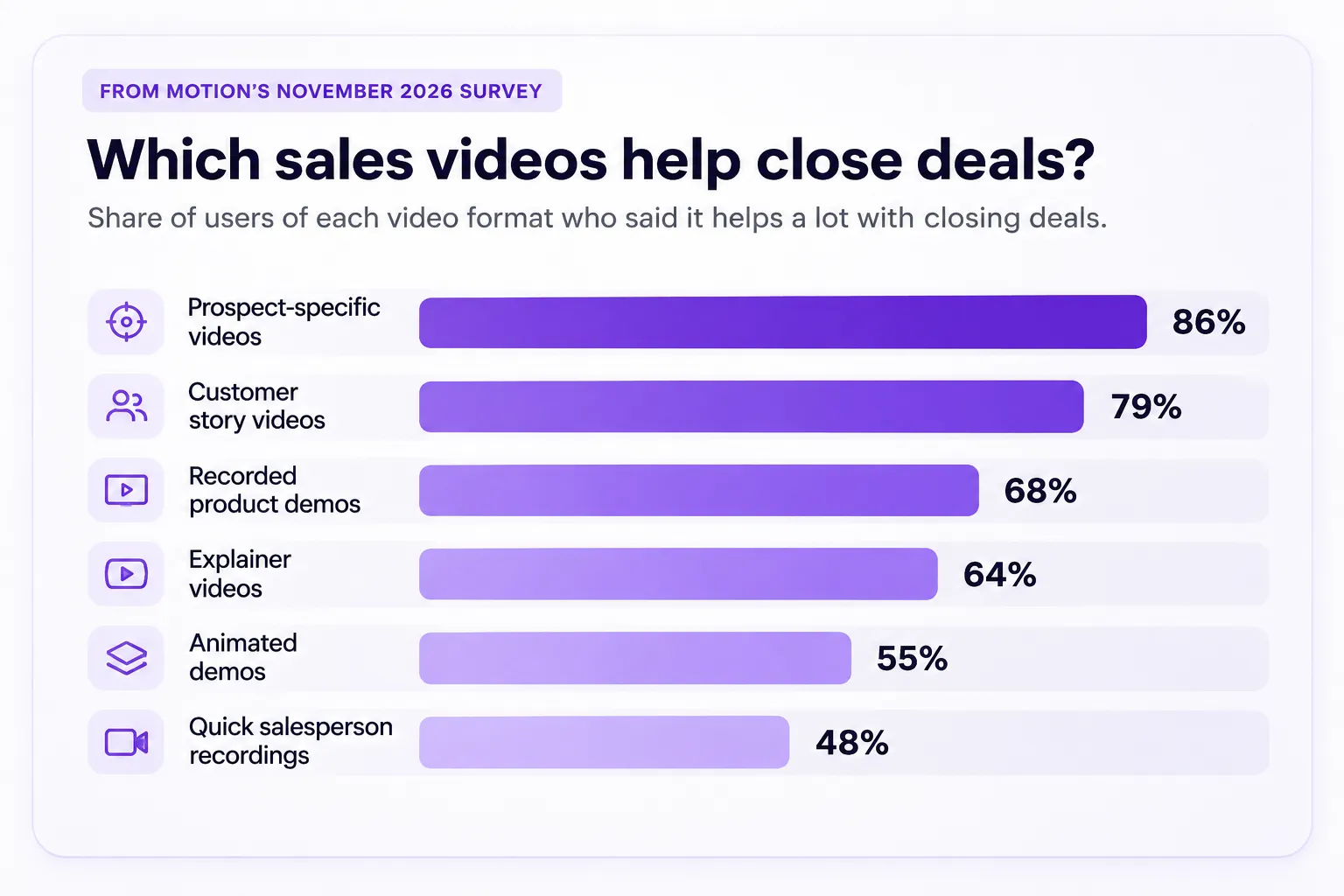
Does that mean quick recordings are less effective? Not necessarily. They're often used to start conversations, while prospect-specific videos and customer stories tend to play a bigger role later in the sales process.
One respondent even reported that video made little difference to their initial outreach response rates, but recorded and animated product demos were more appreciated during evaluation.
The takeaway? The most useful video depends on what you're trying to achieve. A format that works well for capturing attention won't necessarily be the one that helps a buyer make their final decision.
Build Trust Without Losing the Human Touch
A good sales video doesn't just explain your product. It also gives buyers a reason to trust what you're saying.
That trust can come from real customer experiences, accurate product information, or simply hearing from someone who understands their challenges.
Our November 2026 survey highlighted three interesting findings:
And accuracy isn't something to overlook.
One respondent shared how their sales team recorded a video without checking with marketing first and ended up sending incorrect information to a prospect. It's a good reminder that giving salespeople creative freedom still requires some coordination.
On the other hand, another respondent described how a customer appreciated receiving an explainer directly from the managing director who invented the product.
That brings us to another important point: not every sales video needs to be a polished production. Sometimes, hearing directly from someone knowledgeable and familiar is exactly what builds confidence.
The goal isn't to replace human interaction with video. It's to make those interactions more useful, relevant, and trustworthy.
Why Reusable Creative Assets Matter: The Mirakl Example
One thing we always advocate for is that our clients have reusable creative assets. Even for one-off projects, we provide our clients with the working files in case they need to reuse illustrations, animations, or other assets in the future.
But for this section, let's focus on our partnership with Mirakl.
B2B companies constantly need new content as products change, campaigns launch, and customer requirements evolve. That's exactly what happened with Mirakl.
Producing every video independently can take more time and make it harder to maintain brand consistency. What started as a single explainer video eventually grew into a partnership spanning more than 30 videos and 11 Lottie animations.
The collaboration covered product launches, customer interviews, international events, and broader sales and marketing communications. Reusable illustrations, motion graphics, and UI assets provided a foundation for subsequent projects, allowing us to build on existing work rather than starting from scratch every time.
As Savira, one of our designers at Motion The Agency, puts it:
"Having an established visual direction and recurring content structure makes the next campaign easier to produce."
And this isn't just relevant to large-scale partnerships like Mirakl.
Our November 2026 survey found that 48% of the 99 qualified B2B sales leaders said their teams create different video versions for specific industries or use cases.
That means nearly half of the surveyed teams need content tailored to different audiences. And when you're producing multiple versions of similar videos, having reusable assets can make the process much more manageable.
That's what our Mirakl partnership demonstrates. Instead of treating every video as a completely new project, you can build on what you've already created while keeping your content consistent across different channels and audiences.
How to Build a Sales Video Library That Stays Relevant
1. Make Your Sales Videos Easy to Find
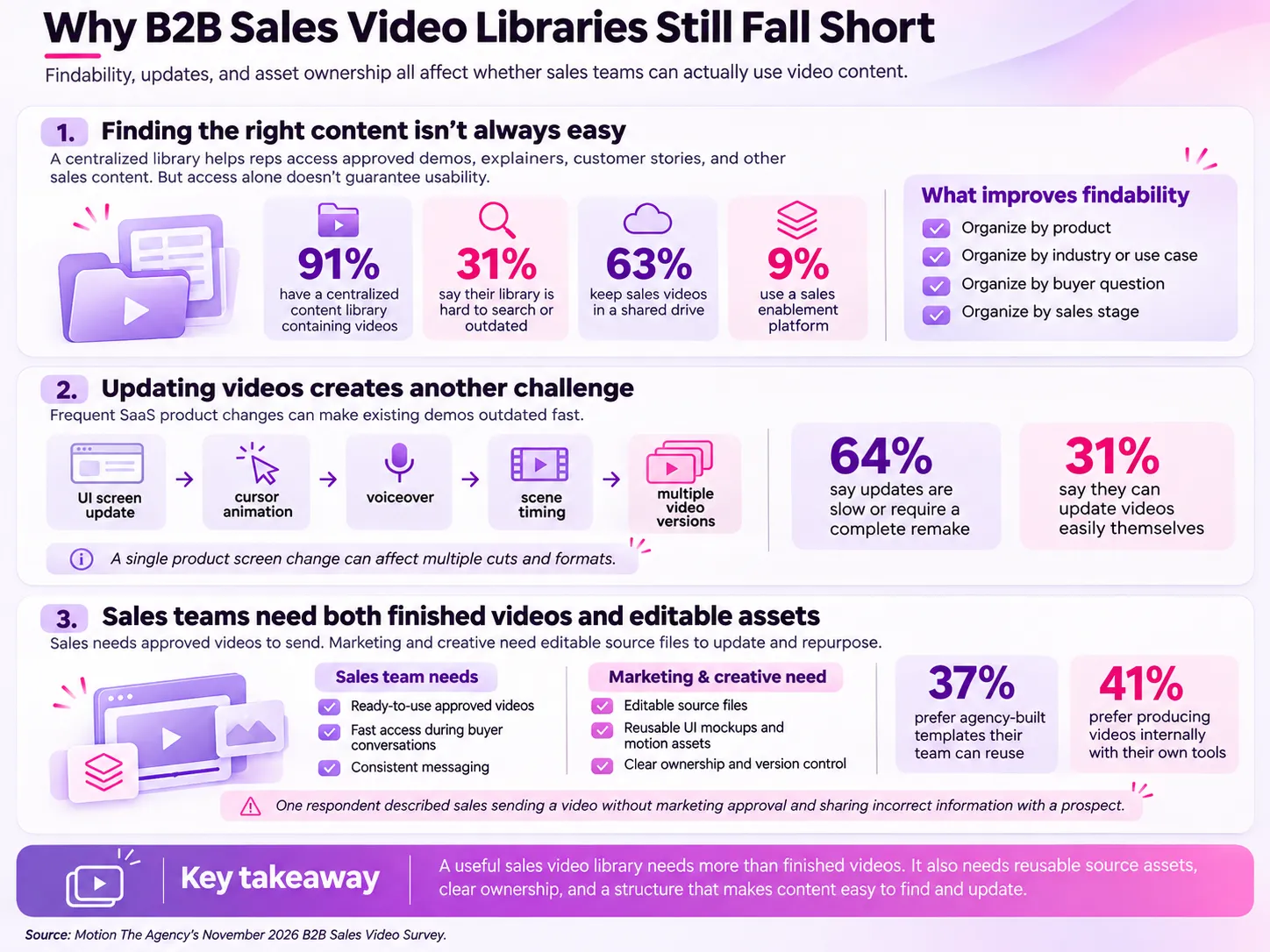
Having a sales video library is great. But what's the point if your sales team can't find the right video when they need it? Our survey found that 91% of B2B sales teams have a centralized content library, yet 31% said theirs was difficult to search or outdated. And with 63% still storing videos in shared drives, things can get messy pretty quickly. Organizing content by product, industry, use case, or sales stage can make a big difference. Your sales reps shouldn't have to dig through endless folders just to find one product demo.
2. Keep Your Videos Easy to Update
Here's something SaaS companies know all too well: products change, and videos get outdated. Even a simple UI update might mean replacing screens, adjusting animations, or re-recording voiceovers. In fact, 64% of our survey respondents said updating videos was slow or required a complete remake, while only 31% could update them easily themselves. That's why reusable assets matter. Having editable UI mockups, illustrations, and animations makes future updates much easier than rebuilding everything from scratch.
3. Build a Library You Can Actually Reuse
A good sales video library shouldn't just be a collection of finished videos. Your sales team needs content that's ready to share, while your creative team needs working files they can edit and repurpose. Our survey found that 37% of respondents preferred agency-built templates, while 41% wanted to produce videos using their own tools. Different approaches, but the same underlying need: more flexibility and control over content. The goal isn't just to have more videos. It's to make the ones you've already created work harder for your team.
Conclusion: Better Sales Videos Start With the Right Strategy
B2B sales video isn't about producing as many videos as possible. It's about having the right video for the right buyer at the right moment.
A quick recording might start a conversation, a product demo can help buyers understand your solution, and a customer testimonial might give them that final bit of confidence to move forward.
But creating those videos is only half the job. You also need to keep them organized, up to date, and ready to adapt as your product and buyers' needs change.
That's why we believe B2B brands should think beyond one-off videos and start building a reusable creative system. One that helps sales and marketing teams produce content more efficiently without sacrificing quality or consistency.
Because at the end of the day, the best sales video isn't necessarily the one with the biggest production budget. It's the one that helps your buyer take the next step.
Not sure what that could look like for your business? Get a free video sample from us and see how we'd bring your product or message to life before committing to a full project.

Wira Wibisana
As a Design & Marketing Specialist at Motion The Agency, Wira loves sharing knowledge, trends and crafting content that helps brands grow through video and design.

In just a few questions, get a tailored estimate for your next video project.




Contact Us
Ready to elevate your brand? Contact us for your
Free Custom Video Sample