How Much Does a Corporate Video Cost in 2026?

table of content
If you’ve landed here, you probably want to know how much a corporate video actually costs. So let’s start there.
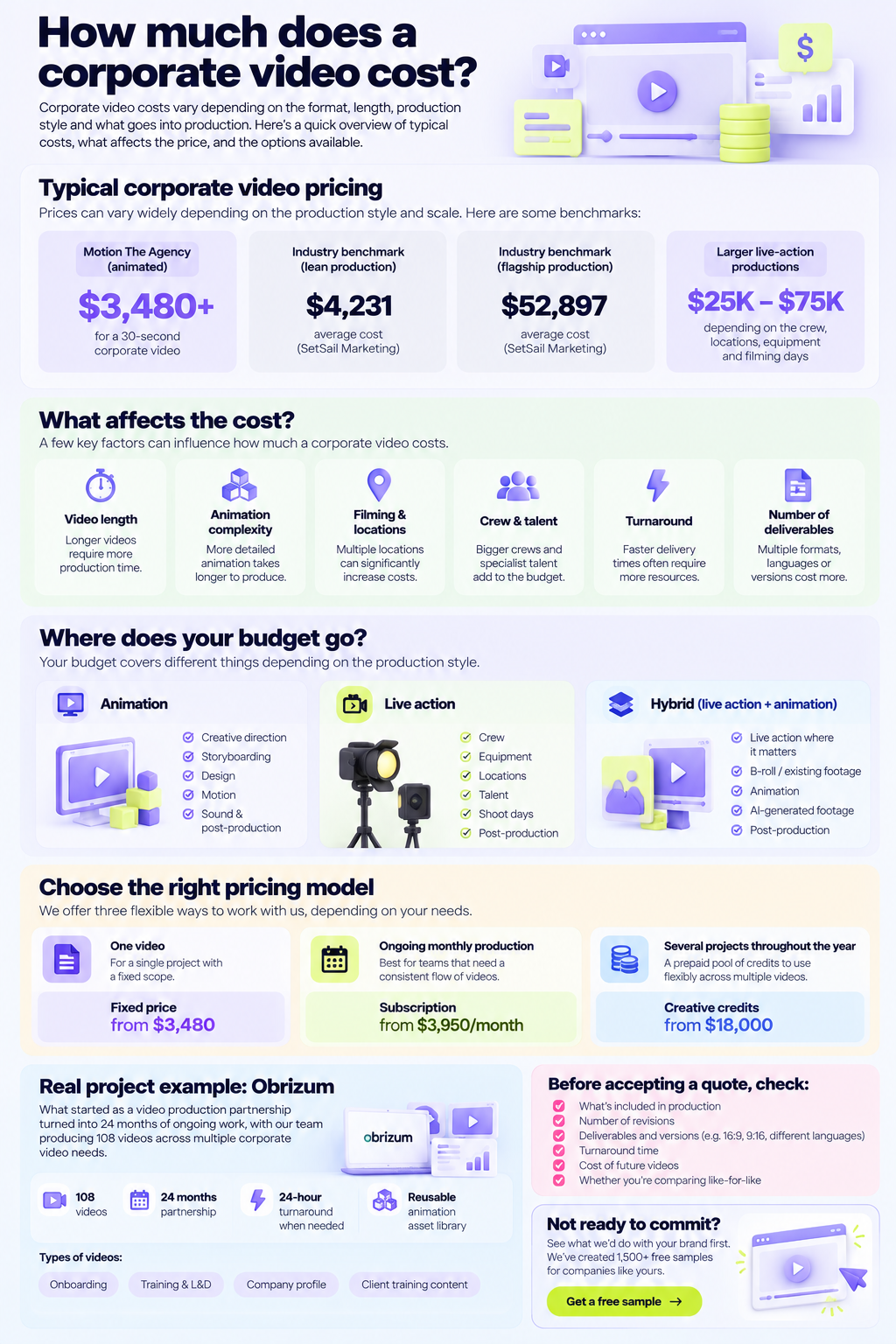
At Motion The Agency, animated corporate video production starts at $3,480 for a 30-second video. Live-action production can be considerably more expensive, with larger productions reaching $25,000–$75,000 depending on the crew, locations, equipment, filming days, and post-production involved.
It’s a big range, but corporate video can mean very different things. A short animated training video is a completely different production from a corporate film involving several locations, a full crew, and days of filming.
When we talk about corporate video, we mean video a company uses to communicate something about the company itself—its people, culture, values, goals, achievements, changes, policies, or responsibilities—to employees, new hires, investors, partners, and other stakeholders.
And there’s a reason companies choose video for this. Some information is simply easier to understand when you can see and hear it rather than read it in another document or presentation. Research published by Athabasca University in Canada found that professionals using video-driven online training achieved a 76.6% knowledge score, supporting the role video can play in workplace learning.
But the format you choose, how long the video is, how it’s produced, and what goes into production can all have a big impact on what you end up paying. In this guide, we’ll break down those costs, what affects them, and where your budget actually goes.
How much does a corporate video cost?
General pricing
Let’s get straight to the numbers.
To give you a benchmark, we’re using pricing data from SetSail Marketing, which breaks video production into three levels: lean, standard, and flagship.
At the lower end, a lean production averages $4,231, while a flagship production averages $52,897.
That’s a huge difference, but there’s a reason for it. Corporate video isn’t one single type of production. A simple animated internal communication video requires a very different setup from a large live-action company film with multiple shoot days, locations, crew members, and equipment.
Motion The Agency pricing
This is where our pricing looks a little different from the live-action benchmarks above.
We’re primarily an animation and motion design company, so most projects don’t automatically come with the crews, locations, equipment, and shoot days that can push up the cost of traditional live-action production.
That doesn’t mean we can’t work with live action either. When a project needs it, we can combine live-action footage with B-roll, animation, existing footage, or AI-generated footage, helping cover scenes that might otherwise require additional filming. We’ve already used this approach across client projects, so we know how to bring those different formats together into one cohesive video.
Our animated corporate video production starts at $3,480, but there isn’t just one way to work with us.
Depending on whether you need one video, ongoing production, or several projects throughout the year, we offer three pricing models: fixed price, subscription, and creative credits.
What we will do for you?
The easiest way to answer that is with a real project.
Take Obrizum. What started as a video production partnership turned into 24 months of ongoing work through our subscription, with our team producing 108 videos across the partnership.
And these weren’t all the same type of video. Through the subscription, we worked across several of Obrizum’s corporate video needs, including employee onboarding videos, training and L&D content, and company profile videos. We also produced training content that Obrizum could use with its own clients.
Beyond the finished videos, we created a library of animation assets that Obrizum could reuse in future videos, making it easier to keep producing new content without starting from scratch every time.
Speed mattered too. When needed, we were able to turn projects around in as little as 24 hours.
So, in practice, the subscription gave Obrizum 108 videos across 24 months, reusable animation assets, multiple types of corporate content, and turnaround as fast as 24 hours—without needing to build that production capacity internally.
What does your budget actually get you?
Knowing what a corporate video costs is useful. But if you’re about to spend thousands on one, you probably also want to know what you’re actually getting for that money.
Across our corporate video work, we’ve worked with 120+ companies from Series A through to Enterprise, and the projects we can track have reached 50,000+ employees.
Some companies come to us for one video. Others end up needing a lot more.
Take Obrizum. What started as a video production partnership turned into 24 months of ongoing work, with our team producing 108 videos across employee onboarding, training and L&D, company profile content, and training materials for Obrizum’s own clients.
But producing more videos wasn’t the only goal. We also built a reusable library of animation assets, so new projects didn’t have to start from scratch every time. And when something needed to move quickly, we could turn projects around in as little as 24 hours.
That meant Obrizum had a team that already knew its visual style, had the assets ready to go, and could keep producing new content as their needs changed—without having to build that production capacity internally.
And that kind of ongoing relationship matters to us. A finished video is one thing, but when a company continues working with us across dozens of projects and multiple years, it gives us a pretty good indication that the process is working for them too.
Across the corporate video projects we can track, we’ve now:
- Reached 50,000+ employees through the videos we've produced
- Produced 100+ corporate videos
- Worked with 120+ Series A to Enterprise companies on corporate video
We don’t have performance data from every project, especially when the videos are internal or confidential, so these numbers only represent the work we can track.
So, which one is right for your corporate video?
The easiest way to decide is to think about what you actually need people to see.
If there’s something physical involved, live action can make a lot of sense. Say you’re creating a training video showing employees how to operate a piece of equipment. Seeing the real equipment, environment, and process is probably going to be much more useful than recreating everything in animation.
But if you’re explaining a process, policy, organisational change, data, or something that doesn’t really exist visually, animation gives you much more freedom. Instead of figuring out what to film, we can create the visuals around what you’re trying to explain.
And you don’t necessarily have to choose one or the other.
We’ve worked on projects where we’ve mixed live action with B-roll, animation, and AI-generated footage. So instead of organising a shoot for every outdoor scene or supporting shot, we can use those approaches to fill the gaps and keep the live-action filming for the moments where it actually matters.
It can make the whole production a lot more practical, especially if a full shoot would mean extra locations, crew, equipment, or filming days. And because we’ve already worked this way on client projects, we know how to bring those different elements together so they still feel like one cohesive video.
That also changes where your budget goes. Live action puts more of it into the physical shoot, while animation, AI, and hybrid production put more into creative direction, design, motion, and post-production.
The important thing here is that not every project carries every cost. An animated corporate video doesn’t need actors, a camera crew, locations, or shoot days. A live-action video might.
That doesn’t automatically make animation the right choice—or even always the cheaper choice. It comes back to what you need to communicate and what needs to be physically captured to communicate it well.
That last paragraph is important. It prevents the section from sounding like “animation = cheap, live action = expensive”, which is too simplistic and would weaken MTA's credibility.
One other thing: if those table figures come from different external sources, I’d make sure every figure is sourced before publishing. For a BOFU article, unsupported ranges like “~$3,000 per 30 seconds” can look arbitrary.
How to get more from your corporate video budget
Getting better value doesn’t necessarily mean making the cheapest video possible. It means spending your budget on the parts of production that actually matter for what you’re trying to communicate.
For example, if your message can be communicated through animation, you may not need to pay for locations, actors, equipment, or filming days. If you already have brand assets or footage, we can build those into the production rather than creating everything again from scratch.
And if you know you’ll need more than one corporate video, commissioning every project individually might not be the most cost-effective way to work.
The right option really comes down to how much video you expect to produce.
If you need one company profile video, fixed pricing probably makes more sense. But if you already know you’ll need onboarding, training, internal communications, company updates, and other videos throughout the year, a subscription can make each project much more efficient than starting a new production from scratch every time.
Avoid paying for production you don’t need
This is where corporate video budgets can get unnecessarily expensive.
More locations, more filming days, more people on set, more complex animation, and more rounds of changes all add to the production. Sometimes they’re completely justified. Sometimes they’re not.
Before spending more, we’d ask a much simpler question: does this actually make the video better at communicating what it needs to communicate?
If it doesn’t, you probably shouldn’t be paying for it.
The same applies to how you buy video production. Paying for 10 individual projects when you already know you’ll need regular video throughout the year may not make sense. Equally, there’s no reason to commit to a subscription if you only need one video.
What should your corporate video quote actually include?
When comparing corporate video quotes, don’t just look at the final price. A cheaper quote can quickly become more expensive if important parts of production aren’t included.
Before you choose, check what you're actually getting:
- Production – Does the quote cover scripting, storyboarding, design, animation, sound design, and final delivery?
- Revisions – How many rounds of feedback are included before you start paying extra?
- Deliverables – Are different aspect ratios, cutdowns, languages, or additional versions included?
- Turnaround – Can they actually deliver before your event, onboarding programme, company announcement, or other deadline?
- Future videos – If you need five, ten, or twenty videos, would commissioning them individually still make financial sense?
Most importantly, compare like for like. A $4,000 animation and a $40,000 live-action production might both be called a corporate video, but what goes into producing them can be completely different.
And if you already know you'll need corporate video regularly, it’s worth comparing the cost of individual projects against an ongoing production model.
See what we can do before you commit
Choosing a corporate video partner can be a pretty big commitment, especially when you’re spending thousands on a project. That’s why you don’t have to commit to a full production with us straight away.
We can create a free sample using your own brand, so you can see the creative direction and what our team can do before deciding whether you want to move forward. We’ve already produced 1,500+ free samples for companies considering working with us.
Our production model is also a little different from a traditional live-action agency. We’re animation and motion design-first, which means most projects don’t require filming days, locations, actors, camera crews, or all the logistics that come with them.
We also use AI where it genuinely helps us speed up production, from early visualisation to production support. But the creative decisions still sit with our team, including the creative direction, design, animation, timing, and final polish.
It’s an approach we’ve now used across 700+ companies, with 240 companies working with us in 2025 alone, including recurring clients.
So if you’re comparing corporate video options but aren’t ready to commit yet, start with a free sample. See what we’d do with your brand first, then decide if you want to take it further.
FAQ

Widi Setyowati
Widi is a content marketing specialist with experience in video marketing, email marketing, and content creation. At Motion The Agency, she specializes in crafting engaging video campaigns, impactful email outreach, and insightful written content.

In just a few questions, get a tailored estimate for your next video project.





Contact Us
Ready to elevate your brand? Contact us for your
Free Custom Video Sample