
What Is Commercial Video? How It Differs From Explainers & Demos

table of content
.png)
Let's talk about commercial videos. What exactly is a commercial video?
A commercial video is a marketing video designed to promote a brand, product, or service by capturing attention, generating interest, and encouraging viewers to take action.
Sounds straightforward, right?
Well, not quite. There's still a lot of confusion around what counts as a commercial video, a marketing video, or a corporate video. These terms are often used interchangeably, even though they're not necessarily the same thing.
So, where do you draw the line?
Before getting into the differences between commercials, explainers, and product demos, it's worth establishing how Motion The Agency categorises marketing and corporate videos, and why that distinction matters.
This distinction is important because it's how Motion The Agency categorises its projects and clients, helping determine what each video should focus on.
- Marketing video: A video created to promote a brand, product, or service by capturing attention, communicating value, generating interest, and encouraging viewers to take action. This includes commercial videos, explainer videos, product demos, promotional videos, product launch videos, customer testimonials, and case study videos.
- Corporate video: A video created to communicate information about a company, including its people, culture, values, operations, and achievements, to internal or external stakeholders. This includes employee training, onboarding videos, company profiles, company culture videos, leadership messages, internal communications, and compliance videos.
The simplest distinction? Marketing videos focus on what a company offers its customers, while corporate videos focus on communicating about the company itself.
Now, within marketing video production, you'll find several types of videos. But for this article, we're going to focus on three: commercial videos, explainer videos, and product demos, and how they differ from one another.
So, what’s the difference between these three types of marketing videos?
Now, before we get into their differences, it's worth remembering that these video types aren't always mutually exclusive. In some projects, they can overlap, but generally, each has its own primary focus.
The way we see it, there are four key things to consider when comparing these three types of marketing videos:
- What makes each distinct: Their objectives, messaging, content, and use cases.
- Where they overlap: How an explainer video or product demo can also function as a commercial.
- Which one to choose: Based on the audience's needs and the campaign's objectives.
- Real MTA examples: How we've helped B2B and SaaS brands combine persuasion, explanation, and product demonstrations within a single video.
In this article, we'll focus on commercial videos, including examples, their goals, and what makes them different from explainer videos and product demos.
Commercial video vs. explainer and product demo video
Commercial videos grab attention. Explainer videos introduce the product. Product demos show buyers why they should care.
A commercial is designed to generate interest and persuade people to take action. It needs a strong hook, a clear message, and a reason for viewers to pay attention.
An explainer is more product-centred, focusing on what the software does and why it matters. A product demo flips that around. It's about the buyer's problem and showing off exactly how the product solves it.
And that changes the first five seconds. A commercial needs to grab attention; an explainer can start by introducing the product, while a demo should get straight to a pain point the buyer recognises.
Nobody wants a tour of every feature. They want to see why the product matters to them.
What is a commercial video?
The main purpose of a commercial video is simple: grab attention, generate interest, and ultimately encourage people to take action.
At Motion The Agency, we've worked on commercials that explain products, demonstrate features, and promote brands. But what makes them commercials isn't necessarily the content itself. It's what the video is trying to achieve.
And there's research that supports the importance of making commercials engaging.
A 2019 study published in Economia & Gestão, involving 368 participants, found that entertainment value was the strongest predictor of whether people wanted to share a commercial video.
So, what does that tell us?
Well, people are more likely to share something they find entertaining. That's why storytelling, humour, and engaging visuals can play such a big role in commercials. You can still explain what your product does, but you need to give people a reason to pay attention first.
That's also why commercial videos tend to keep things simple. Rather than walking viewers through every feature or technical detail, the focus is on getting one clear message across to the right audience and giving them a reason to care.
The simplest way to tell them apart
The easiest way to distinguish these three types of marketing videos is to look at what each one focuses on:
- Commercial video: Defined by its marketing objective.
- Explainer video: Defined by its communication approach.
- Product demo: Defined by its content and level of product detail.
But here's where things get interesting. These aren't mutually exclusive categories.
A product demo can work as a commercial if its main purpose is to drive sign-ups or conversions, and in some cases, build awareness. An explainer can do the same when it's designed to persuade viewers and encourage them to take action.
And a commercial that walks viewers through specific product features could just as easily be considered a demo.
So, no. You don't necessarily need three separate videos.
The better question is what your campaign promises and how much your audience already knows.
If you're introducing an unfamiliar product and trying to reach new audiences, an explainer is a sensible choice. It gives viewers enough context to understand what the product does and why it's worth their attention.
But don't confuse explaining with engaging. If impressions and reach are the goal, the video still needs a strong hook. Nobody's going to sit through a lengthy product introduction just because it's informative.
Now, say your audience already knows the brand. The campaign is targeting a specific customer pain point, and the goal is to generate sign-ups or demo requests.
That's where a product demo becomes particularly useful.
Rather than listing every feature, show the workflows that solve the problem your campaign is promising to address. Give buyers a reason to believe the product can actually deliver.
Of course, neither format is restricted to one stage of the marketing funnel.
What matters is what buyers already understand, what's holding them back, and what they need to see next to make a decision.
What makes a commercial video effective?
There's no one-size-fits-all formula for making a commercial video effective. What works for one brand might not work for another.
But from our experience working with B2B and SaaS companies, there are a few things we've found that can make a real difference.
Here are the key elements we pay attention to when creating commercial videos.
- A strong hook: You've only got a few seconds to get someone's attention, so make them count. Whether it's a problem your audience can relate to, a question that gets them thinking, or something unexpected on screen, your opening needs to give people a reason to stop scrolling and start watching.
- A clear message: We've seen plenty of brands try to fit everything about their product into one video. But the more you try to say, the harder it is for people to remember anything. Pick one key message you want to get across and make sure everything in the video supports it.
- Audience relevance: Your commercial doesn't need to speak to everyone. It just needs to resonate with the people you're trying to reach. Think about what they actually care about, the problems they're dealing with, and why your product would matter to them.
- Entertainment and usefulness: Getting someone's attention is one thing. Keeping it is another. Storytelling, humour, and engaging visuals can help, but they need to serve a purpose. The best commercials give people something worth watching while communicating something valuable, whether that's a new perspective or a clearer understanding of your product.
- A clear CTA: You've got their attention, they've understood your message, now what? Don't leave people guessing. Whether you want them to visit your website, book a demo, or sign up, make sure the next step is clear and easy to follow.
Example of a commercial video
CallRail: Commercial videos for CTV advertising
CallRail is one of our largest ongoing commercial video projects, particularly for paid advertising. And it's a good example of why one commercial isn't enough for an entire advertising campaign.
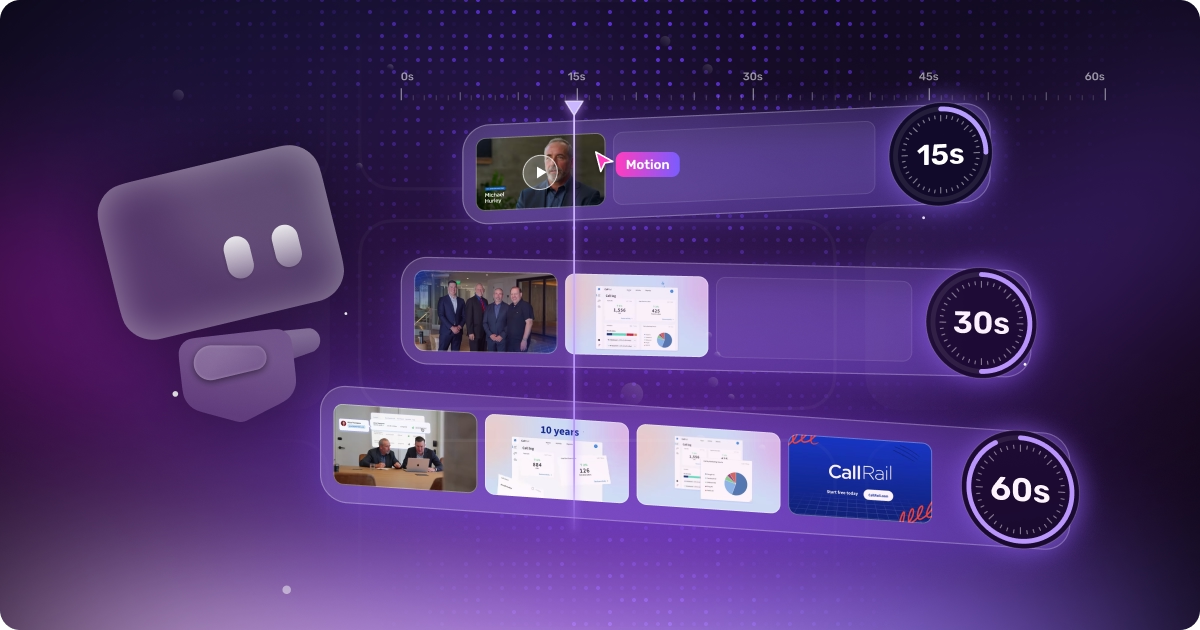
The partnership now covers multiple campaigns across connected TV (CTV) and paid social media, with videos ranging from 6-second bumper ads to 90-second commercials.
Throughout 2026, Motion has produced 16 CTV advertising assets, including work for the Two Voice Assist campaign, with placements such as the NFL and US Open.
But these videos aren't just different lengths for the sake of it.
Each has a job to do at a different stage of the customer journey. The shorter ads grab attention and reinforce CallRail's message, while the longer ones have more room to develop a story and explain why the product matters.
And producing that many variations isn't always straightforward.
With campaign plans still being finalised and deadlines approaching, changes to the creative were inevitable. That's where batch production made a difference, allowing the team to reuse assets, adapt scenes, and manage multiple deliverables without starting from scratch every time.
As for the results, CallRail reported "amazing traction" from its March Madness campaign. There aren't verified performance figures to share, but the partnership has continued across multiple campaigns.
The point is that a six-second bumper and a 90-second commercial shouldn't be trying to do the same job. The length, message, and creative approach need to match what the campaign is trying to achieve.
Adaptify: Motion graphics ads for digital campaigns
We've worked with Adaptify on 28 motion graphics ads for their digital campaigns, covering everything from feature launches to product promotions.
What makes this project interesting is that we started with Loom recordings of their product features and turned them into engaging, hook-driven commercials.
Rather than simply showing how the product works, we used animation to highlight key benefits, capture attention, and give viewers a reason to care. So, while the videos were informative, their main purpose was still promoting the product and generating interest.
The videos also needed to work across different platforms, from paid social media to TV advertising, so flexibility was an important part of production.
To support Adaptify's ongoing campaigns, we used our subscription model, allowing us to create and adapt advertising content consistently.
When should you choose a commercial video?
Not every marketing objective needs a commercial video. But if your goal is to capture attention, generate interest, and encourage people to take action, it's worth considering.
For B2B brands, commercial videos are particularly useful when you want to move beyond explaining what your product does and start giving people a reason to care about it.
And remember, you don't necessarily need to produce something entirely new. An existing explainer or product demo can also work as a commercial when it's adapted with a more persuasive message and a clear marketing objective.
Conclusion
So, is a commercial video really that different from an explainer or product demo? Well, yes and no.
The biggest difference comes down to what you're trying to achieve. Commercial videos are designed to grab attention and generate interest, explainers help people understand your product, and product demos show them how it actually works.
But as we've seen with our work for CallRail and Adaptify, one video can do all three. You can explain a feature, demonstrate its value, and still create something persuasive enough to work as an ad.
Before deciding which type of video you need, ask yourself one thing: What do I want my audience to think, understand, or do after watching?
That's where a good video starts.
And if you're still figuring out which approach makes sense for your brand, get a free sample from us. We'd love to bring your vision to reality.

Widi Setyowati
Widi is a content marketing specialist with experience in video marketing, email marketing, and content creation. At Motion The Agency, she specializes in crafting engaging video campaigns, impactful email outreach, and insightful written content.

In just a few questions, get a tailored estimate for your next video project.





Contact Us
Ready to elevate your brand? Contact us for your
Free Custom Video Sample