Commercial Video Production: Process, Costs, and Examples (2026 Guide)
table of content
Key takeaways
- Commercial videos are one of the most effective marketing tools today, especially with short-form content dominating most platforms.
- They work because they stop the scroll, spark interest, and guide viewers toward real action like buying, signing up, or remembering your brand.
- Animation, live action, and hybrid formats all have their strengths. The best choice depends on your message, product type, and how abstract or human your visuals need to be.
- Costs vary widely across the industry, but Motion The Agency provides clear, predictable pricing across Basic, Premium, and Enhanced packages, with flexible options for animation-only work.
Commercial video production
We’ve talked about almost every type of video in our blogs except for one of the services people ask for the most: commercial videos. If you’ve been online at all lately, you’ve definitely noticed how brands use video to grab attention, which is exactly why Motion The Agency offers commercial video production services for tech and SaaS brands globally.
A commercial video (or brand video) is a short, persuasive piece of content designed to market a product, service, or brand. Its job is simple: stop the scroll, spark interest, and guide people toward an action, whether that’s buying, signing up, or just remembering the name.
What’s wild is how fast the format is evolving. Short-form content has taken over, with about 66 percent of ads now running under 30 seconds. That shift makes motion-based formats like animated explainer videos and product demos even more powerful because they deliver the message quickly without losing clarity.
And here’s the kicker: 84 percent of businesses say video has helped increase their sales. It doesn’t matter if it’s a simple 2D animation or a polished live-action shoot, the medium works. Commercial video production for brands has become one of the most effective ways to tell their story and actually get results.
Here are some of the most common types of commercial videos:
- The brand anthem: Focuses on emotional storytelling, often relying heavily on live action to create a strong audience connection.
- The animated product deep dive: Uses motion graphics to explain and showcase the product or service in detail, making it ideal for complex or technical content.
- The hybrid commercial: Combines live action with motion graphics to show real people interacting with the product or interface, making it perfect for tech and app-driven brands.
Now the question is, which one does your company need, how do you create a commercial video, and how do you decide which style fits best? Let’s talk about it here.
Why choose animation over a camera?
Budget is often one of the first things marketers consider when choosing between animation and live action. But animation’s value is not just that it can cost less. It also gives your team more control, speed, and flexibility.
We see this a lot with software brands. Across the 183 clients and 233 projects we analysed, 52% of our clients are SaaS or software companies, 79% sell software or a software-supported service, and 58% of the videos we create are explainers. It makes sense: when your product involves interfaces, workflows, or ideas that cannot easily be filmed, animation gives you more ways to show how everything works.
It is also easier to make changes. If your product, messaging, or CTA is updated, you can revise the animation without organising another shoot. The same visual system can then be turned into different ads, lengths, and aspect ratios for multiple platforms.
That is where animation becomes especially useful. Instead of creating one commercial and moving on, your team gets a flexible set of assets that can be tested, reused, and improved over time.
What an animated commercial video actually is
An animated commercial video is a short promotional video that uses animation to advertise a product, service, or brand rather than relying entirely on filmed footage. These videos are commonly produced in shorter lengths such as 15, 30, or 60 seconds, depending on where the ad will be shown and how much information needs to be communicated. Because the assets are created digitally, one main commercial can also be turned into shorter cutdowns, different aspect ratios, and platform-specific versions, making it easier to get more use from the same production.
For software and SaaS brands, that might mean animating an interface, simplifying a workflow, or turning an abstract benefit into something viewers can understand quickly. It could be a fully animated ad, a product-focused explainer, or a hybrid video that combines live action with motion graphics.
The goal is not to add movement for the sake of it. Good animation helps people understand the product, remember the message, and know what to do next
Choosing between live action and animation for your commercial video
The first thing to recognize is that this is not an apples-to-apples comparison. Live action will almost always have an advantage when it comes to aspects like realism, human emotion, and showing real-world experiences. However, the way we look at it is through a different lens: the type of product you are trying to communicate.
The key difference comes down to whether the product is tangible or intangible. For physical products and lifestyle-led brands — such as luxury, fashion, automotive, or many B2C products — live action often has the upper hand because it can capture real environments, people, and emotional connections. However, for intangible products like SaaS platforms, AI tools, and digital services, animation can provide a stronger advantage by visualizing complex ideas, explaining workflows, and showing experiences that cannot be captured through traditional filming.
"It comes back to tangible versus intangible. Live action still has its place, but it works best when you're alluding to a certain lifestyle, or when the product is physically real. If you've got a service offering, animation is much better at conveying it. That's why vector-based animated design is so big for tech companies — software is intangible." Sam Jupp.
The table above is probably the easiest way to look at where each approach makes the most sense. Live action naturally has an advantage when you need to show something real — physical products, people, environments, and the lifestyle around a brand. Animation becomes more valuable when you need to explain something that is difficult to capture in real life, such as SaaS products, AI tools, workflows, or complex systems.
Since we are a motion-forward agency, we naturally lean towards animation because of how flexible it is for explaining ideas and products that do not have a physical form. That said, we do not see animation and live action as competing approaches. We often work on hybrid projects where we combine client footage, stock footage, or AI-generated video with motion graphics to create something that feels both human and easy to understand.
The simplest way to think about it: use live action when you want people to connect with the human side of a product, and use motion graphics when you need to explain what is happening behind the scenes — whether that is data, automation, security, or a digital workflow.
Steps of commercial video production
Okay, let’s answer this question first. Just like any of our other projects, commercial video production steps can be divided into three categories: pre-production, production, and post-production. In general, every type of project we handle follows a similar workflow, which is what makes us effective. But each video type still needs its own adjustments, so we refine parts of the process to fit what the project needs most. And this is how we approach commercial video.
Pre-production
Pre-production is where the entire commercial video starts taking shape. This phase sets the foundation for everything that comes after, so getting it right is crucial.
- Goal-setting and audience research: Before anything else, we need to understand why the video exists and who it’s speaking to. This means getting clear on the client’s marketing objectives, key message, and the specific audience we’re trying to reach. A commercial video for a fintech SaaS product will look very different from one for an e-commerce brand, so aligning early prevents wasted time and revisions later.
- Scriptwriting and storyboarding: Once the goals are locked in, we start shaping the actual story. This is where we outline the message, write the script, and create a storyboard that visualizes each moment of the video. Whether it’s animated or live action, a strong storyboard gives everyone, from the client to the production team; a clear roadmap of what the final product will look like. It’s also the stage where we solve most creative challenges before they become expensive.
- Style direction, planning, and logistics: After the message and story are defined, we choose the video style based on what we already aligned on during the initial planning. This could be fully animated, live action, a product demo, or a hybrid approach if the client provides footage. This stage is also where we finalize the budget, timeline, deliverables, visual direction, and any production requirements. For animation-heavy projects, this means gathering brand assets, defining illustration or 3D styles, and prepping UI or product references. For hybrid videos, this might include reviewing client footage, selecting stock, or establishing the visual integration plan.
Production
Production is where all the planning finally turns into real, tangible content. Since we are an animation-forward agency, this stage primarily involves building out animated sequences and integrating any external footage when needed.
- Creating the commercial: This is where everything starts moving. Because we do not handle live-action shoots in-house, any human element in the video comes from client-provided raw footage, AI-generated video, or carefully selected stock footage that we will enhance and integrate into the project. For fully animated projects, our team begins building scenes, animating UI elements, crafting transitions, and shaping the visual story. For hybrid-style projects, we blend animation with the provided or sourced footage to create a seamless and polished narrative. Every detail matters here, from pacing and motion to how each scene supports the core message.
- Ensuring technical quality: Production quality directly affects how the final video feels. Smooth animation, clean timing, consistent lighting, accurate UI flow, and thoughtful motion design all contribute to a professional result. Even small technical choices such as easing, color accuracy, typography, or audio sync help elevate the viewer’s experience and reinforce the brand identity.
Production is where ideas turn into visuals. It is the stage where the project gains personality, movement, and energy, setting the tone for the final refinement in post-production.
Post-production
Post-production is the final stage where all the animated scenes come together and the video is polished into a finished, ready-to-publish commercial. Even though animation doesn’t require things like color grading for physical footage, the post stage is still crucial because it handles refinement, consistency, sound, and output.
- Refining motion and visuals: We adjust animation curves, easing, timing, visual consistency, lighting (in 3D), and any effects that help the video feel polished. This stage is often where a good animation becomes a great one because small refinements make a huge impact.
- Sound design: Sound is a major part of making an ad feel engaging. Post-production involves adding and fine-tuning elements such as:
- Background music
- Sound effects
- UI clicks or swipes
- Swooshes, pops, wipes, and transitions
- Voiceover integration: If the project includes voiceover, this is where the track is cleaned, synced, paced, and mixed with the music so everything sounds balanced and professional.
- Final rendering: Once everything is locked in, we render out the master file in the required formats. For commercial ads, this can include:
- 16:9 or 9:16 for YouTube or website
- 1:1 or 4:5 for social
- 9:16 for ads and TikTok
AI actually changes things here
AI has definitely changed parts of how videos are made, but it is not replacing the creative process behind them. Instead, it helps speed up different parts of the workflow — from exploring ideas and creating early concepts to helping with certain technical parts of animation.
The biggest changes are usually around:
- Cost efficiency — Helping reduce time spent on repetitive tasks and making parts of production more efficient.
- Turnaround speed — Allowing teams to test ideas, create iterations, and move faster through production.
- Creating variations — Making it easier to adapt content into different styles, formats, or versions.
The way we see it, AI is another tool that helps the team work smarter. It can support everything from the first idea to parts of the animation process, but the creative direction, storytelling, and decisions behind the work still come from people.
Animated commercials worth studying
In this section, we’ll look at two examples of animated commercial videos — one using 2D animation and the other using 3D animation. We’ll break down why we consider them strong examples and what makes them effective as animated ads.
These examples are not the only great animated commercials out there, but we chose them because they clearly communicate their message, use animation in a meaningful way, and show how different animation styles can help brands capture attention and explain their products effectively.
Notion
The video walks through Notion’s main features and shows how users can use the platform to organise their work, collaborate, and get more done.The video includes screen recordings, voice-over explanations, and animations to clearly show what the product can do.
For longer-form commercial videos, which are usually targeted at a MOFU audience, the focus shifts from just creating awareness to helping people understand the product better. This means showcasing the main features and benefits through real-life examples, so viewers can see how the product fits into their workflow and solves their challenges.
Notion works well because it combines real product walkthroughs, clear narration, and simple visuals to show how the platform supports both individual productivity and team collaboration.
Copper.co
Our project with Copper uses clean, dynamic visuals that immediately capture attention within the first 1–3 seconds. Beyond creating an engaging opening, the combination of 2D and 3D animation helps visually communicate the product upgrade — which is the main focus throughout the video. With the core message being “Copper’s new dashboards and features make CRM workflows smarter, clearer, and more powerful,” the purpose of the video is clear from the start.
The video works because it combines the clarity of 2D animation with the depth and visual impact of 3D elements, making technical updates feel more engaging and premium. Rather than presenting the launch as just another feature announcement, the visual approach helps tell a bigger story about product evolution and brand progression.
The key takeaway is to position feature updates as forward momentum for the brand, not just a list of improvements. By using layered visuals and combining different animation techniques, brands can communicate growth, sophistication, and the bigger impact of their product changes.
Our experience with commercial video production
By this point in the blog, you have probably noticed that we are a very animation-forward agency. We will always recommend animation whenever it makes sense because it gives us the most control and clarity. That said, we also pride ourselves on being flexible. We can produce strong hybrid videos when clients provide raw footage, or when we use AI-generated video or high-quality stock footage to bring the human element into the project. so these are two of our recent commercial video:
CallRail
CallRail is one of our biggest projects specifically focused on paid advertising videos. We work with their team in batches, aligned with their yearly campaigns and advertising needs. So far in 2026, we have delivered 10 finished assets for their CTV advertising, covering a range of formats — from short bumper videos for skippable ads to longer 30–60 second commercials.
By September this year, we have been supporting a large part of CallRail’s video advertising output, including their Two Voice Assist CTV campaign, which was created for major placements such as the NFL and US Open. The project showcases how animation can help brands create scalable, campaign-ready content across different platforms while maintaining consistency in messaging and visual quality.
The challenge: Since most of CallRail’s projects are tied to bigger campaigns and paid placements, timelines can be pretty tight. The videos often need to be ready around specific launch dates, while also going through feedback and approvals from multiple people internally.
That balance between moving quickly and making sure everyone is aligned is something we’ve had to manage throughout the partnership. Thankfully, our workflow allows us to stay flexible, adapt to feedback, and keep things moving without slowing down production. In the end, the videos have performed really well across their ad placements and continue to support CallRail’s wider campaign goals.
Tasker
One of the hybrid projects we worked on recently was with Tasker. The video itself followed a simple talking-head format, with the main subject speaking directly to the camera, but the goal was to make it feel more dynamic and product-focused. So we mixed in motion design to bring their message to life. In some sections, we even switched completely to stylized UI animation to explain features in a clearer, more engaging way than live action alone could. The final result delivered a nice balance: real human presence paired with animation that breaks down the product in a way that actually makes sense to viewers.
The challenge: Tasker shared their raw footage with us, but the tricky part was timing. They were right in the middle of an internal rebrand, which meant their visuals and messaging kept evolving while we were already working on the video. Naturally, this stretched the timeline a bit because we had to keep adjusting the animation to match the new brand direction. But that’s part of the process, and it’s something we’re used to handling.
Even with the shifting brand elements, the video came together really well. It’s a great example of how hybrid videos can work smoothly when clients provide footage and how animation can step in to fill gaps, enhance clarity, and make the whole piece feel more polished.
Hyperexponential
We recently partnered with Hyperexponential (HX) to help communicate their advanced underwriting technology in a way that feels modern, clear, and visually engaging. To bring that story to life, we blended AI-generated visuals with motion graphics to simplify concepts that are normally impossible to show with live footage. Things like predictive modeling, risk analysis, or data flows don’t exist in the real world, so animation became the perfect tool to make those ideas feel intuitive and easy to understand.
Internally, this is still one of the videos we’re incredibly proud of. It challenged us, taught us a lot, and pushed our workflow forward in the best way possible. It also opened the door to more complex, AI-supported commercial videos, and we’re genuinely excited to take on more projects with similar needs.
The challenge: This project pushed us creatively and technically. At the time, this was a completely new type of brief for us. We had used AI here and there to support parts of our workflow, but the tools weren’t nearly as advanced as what we have today. That meant a lot of experimentation, testing, and figuring out how to use AI without compromising quality.
We used both Midjourney and Google’s Nano Banana (Gemini 2.5 Flash Image) to generate visual elements that matched the tone and style HX needed. From there, we combined the AI outputs with our animation work, making sure everything looked cohesive, polished, and natural. One of the biggest goals was avoiding that “choppy” or “stiff” AI look you see in a lot of videos. So every AI-generated piece went through careful refinement to maintain a professional finish that blended seamlessly with the rest of the video. We actually talk more about our AI workflow in our blog "AI Generated Image& Animation Workflow"
How much does commercial video production cost?
Live action production
Okay, so this is based on comparing other agencies that has this service. A professionally produced 30-second commercial can vary widely in cost depending on the level of production, crew size, talent, location, and post-production requirements. Industry sources place the range anywhere from about $10,000 to $50,000 for a standard, well-executed spot, according to Simulmedia. Broader estimates from Vidico show that costs can start as low as $1,000 and rise past $50,000 depending on complexity. Some production guides, like Farallon, note that when you factor in a full creative team and high-end execution, the average budget often lands between $25,000 and $150,000+ for a 30-second commercial.
Animation
When it comes to animation-based commercial videos, the cost really depends on how detailed and complex the visuals need to be. For 2D animation or motion graphics, a 30-second spot usually falls somewhere between $1,000 and $7,000, depending on how intricate the graphics and storytelling are. If you want something more polished with custom illustrations or smoother character animation, mid-tier ads often land in the $2,000 to $5,000+ range. And for projects that need 3D or more advanced animation, the budget can go up to $3,500 to $25,000+ for a 30-second video, since rendering, lighting, and complex movement take more time and resources to get right.
Motion The Agency
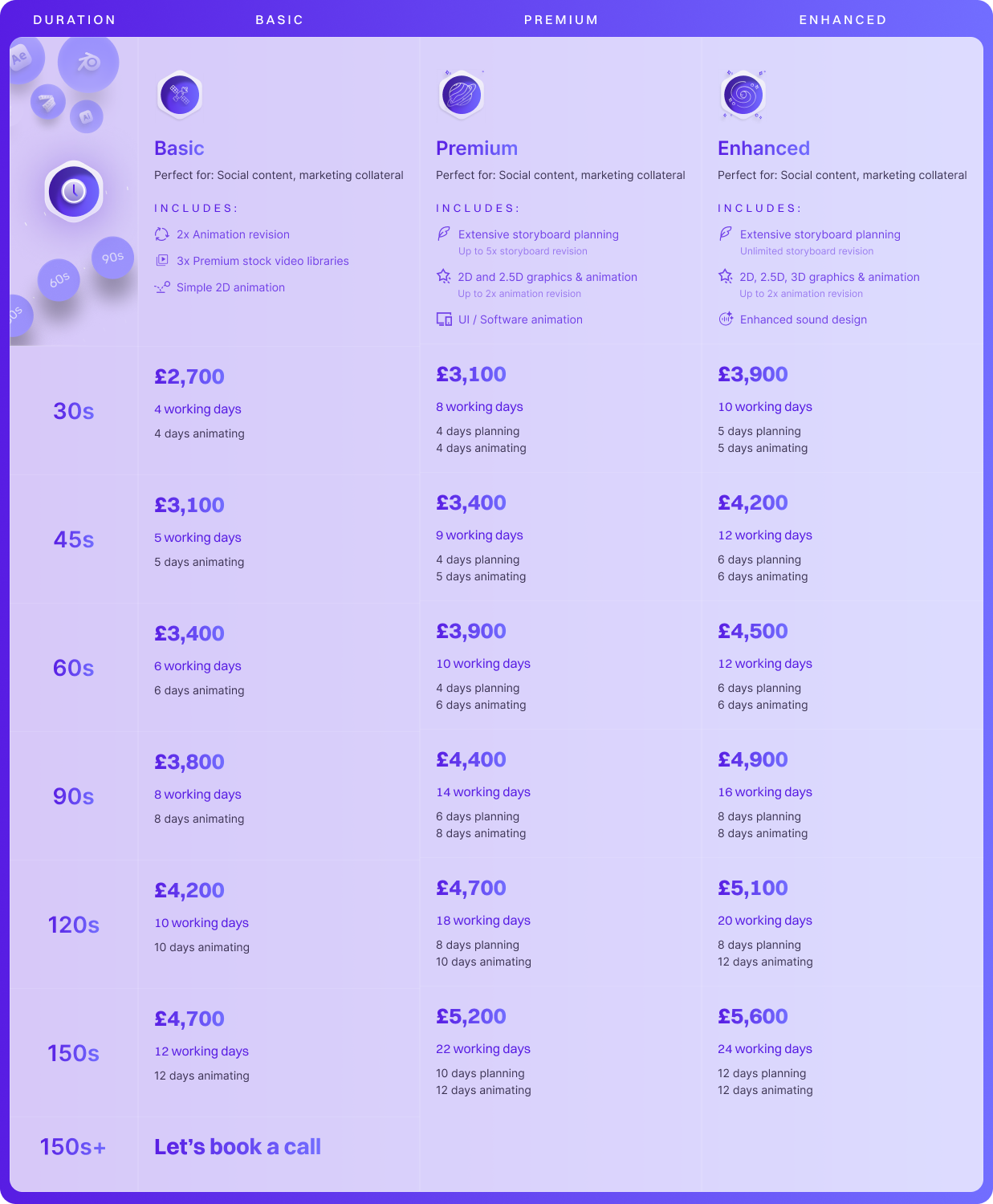
This table gives a clear breakdown of how our pricing works across three package tiers: Basic, Premium, and Enhanced. Each tier is designed for different needs, whether a client wants simple motion graphics, a more polished or even 2.5D animation, or a fully crafted animation with advanced visuals and sound design, or even 3D animated video.
Our pricing starts from £2,700 to £5,600 for videos between 30 and 150 seconds. Shorter videos like 30 or 45 seconds sit at the lower end of the range, while longer pieces such as 120 or 150 seconds land at the higher end because they require more planning and animation time. For projects where the client provides raw footage, we only charge for the animation or motion graphics work, which can make hybrid videos more cost-efficient.
Now that we’ve broken down everything you need to know about commercial video production, what do you think? Feeling ready to start your next project? If the answer is yes, we’d love to hear what you’re planning. Feel free to book a call with us and let’s bring your idea to life together.
Get your free sample
Frequently asked questions (FAQ)

Syarafina Kuswahyuni
Syarafina Kuswahyuni is a content marketer at Motion The Agency, where she covers explainer video production, motion design trends, and video marketing strategy for SaaS brands. She has worked alongside Motion's animation team on projects for clients including ClickUp, Apollo.io, and HackerRank


Bramuda
Bramuda is a creative strategist at Motion The Agency, where he writes compelling blog posts that support and expand upon the agency's video projects for SaaS brands. He works alongside animation team to create cohesive content campaigns for clients including Kuberno, Primer, and Dext.
In just a few questions, get a tailored estimate for your next video project.




Contact Us
Ready to elevate your brand? Contact us for your
Free Custom Video Sample