SaaS Video Marketing: US vs UK, what Our Clients How
table of content
Motion The Agency works across different time zones, with team members and clients based in different parts of the world. That gives us a useful view of how companies in different markets approach video, what formats they keep coming back to, and which ideas seem to work across industries and regions.
One question that often comes up in SaaS video marketing for the US and UK is whether companies need a completely different video strategy for each market. It is a fair assumption. The audiences are different, the tone can be different, and even the way companies talk about their products may change.
But when we looked at our own client data, the result was more straightforward than expected. US and UK SaaS companies buy a very similar mix of videos, with explainer videos leading in both markets. So, the more useful question is not simply, “Is this for the US or the UK?” It is “What does the product need to explain, and what does the audience need to understand?”
Where do we get our data
Before we get into the data, a quick disclaimer. Everything in this article is based on the projects and clients we have worked with over the past few years. That means the patterns we see reflect Motion The Agency’s own client base, services, and way of working, rather than the entire SaaS market.
Other agencies may see something different, especially if they focus on different industries, markets, company sizes, or types of video. So, we are not presenting this as a universal rule for how every SaaS company behaves. It is simply an honest look at the patterns that have shown up repeatedly across our own work.
To make the data more useful, we grouped our projects in several different ways, including location, company stage, video type, industry, target customer, and product type. That allowed us to look beyond the overall numbers and ask more specific questions, like whether US and UK companies buy different types of video, whether startups behave differently from scaleups, or whether certain formats appear more often for SaaS and software companies.
The goal is not to prove that one market always behaves a certain way. It is to use the data as a useful reference point and show what we actually see from the companies that come to us. And in this case, the most interesting finding is not how different US and UK SaaS companies are, but how similar their video needs actually seem to be.
What our US and UK client data shows
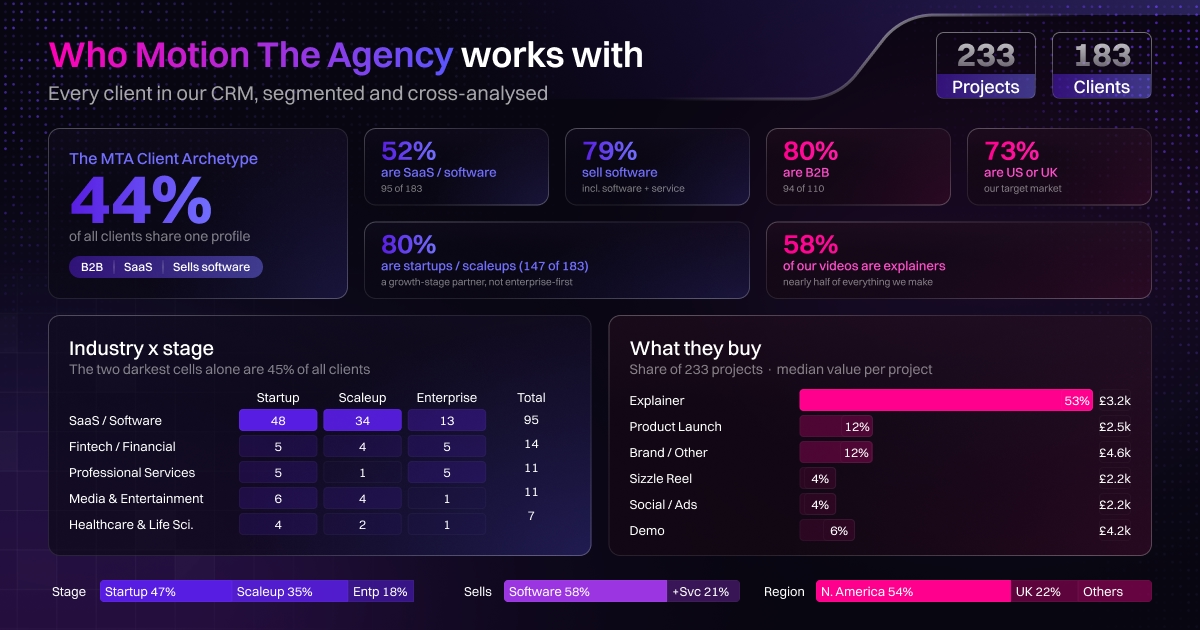
When we looked at the clients in our dataset whose country we could identify, around 53% were based in the US and ~20% were based in the UK. That means a large part of our work comes from these two markets, giving us a useful basis for comparing the kinds of videos SaaS and B2B companies are actually commissioning.
What makes the comparison more useful is that we work with very similar types of companies on both sides. Around 82% of our US clients are B2B companies, including Stagwell and AI Engineer, compared with around 76% of our UK clients, including Kuberno and Obrizum. The company stages are surprisingly similar too: 47% of our US clients and 50% of our UK clients are startups, while 34% of US clients and 37% of UK clients are scaleups. The biggest difference appears at the enterprise level, which makes up around 19% of our US clients compared with 11% in the UK.
So, in both markets, much of our work comes from growing B2B companies selling software, introducing technical products, or trying to make an increasingly complex product story easier for buyers to understand. That makes the comparison more useful because we are not looking at two completely different groups of companies. In many cases, they are dealing with very similar marketing and product communication challenges.
It is worth keeping the scale of the data in mind, though. These figures reflect Motion The Agency’s own client base, not the entire US or UK SaaS market, and the UK sample is smaller than the US one. So we treat the UK numbers as directional rather than definitive. Even with that caveat, the overall pattern is pretty clear: the companies we work with in the US and UK are much more similar than different.
Do they want the same thing?
Explainer videos lead in both
One of the clearest similarities in our data is how often both US and UK clients choose explainer videos. In each market, explainer videos account for roughly 54–56% of what clients buy, making them the most common format by a clear margin.
And that actually makes a lot of sense. As we discussed in our “Video for Startups vs Scaleups” article, explainer videos are one of the go-to formats for SaaS companies and startups, especially when they are introducing something new or trying to make a complex product easier to understand. With startups and scaleups making up the majority of our clients in both the US and UK, it is not surprising that explainers come out on top.
In both markets, the job of the explainer is also very similar: helping buyers understand what the product does, why it matters, and how it fits into their day-to-day work. So even though the companies are selling to audiences in different countries, the core problem they are trying to solve with video remains largely the same.
That said, this pattern is specific to the kind of agency we are and the clients we work with. Motion The Agency focuses heavily on SaaS, software, and B2B companies, so another agency with a very different niche may see a completely different picture of what US and UK clients buy. For example, an agency focused on consumer brands, ecommerce, or live-action campaigns may find that the most common formats in each market look very different.
The wider mix is also similar
Explainer videos are the clearest common ground, but the similarity does not stop there. When we look at the rest of the video formats, US and UK clients still follow a broadly similar pattern. Product launch videos, brand or company videos, demos, social content, and sizzle reels all appear in both markets, with no single format suddenly becoming dominant in one country and almost disappearing in the other.
There are small percentage differences between the two markets, but they are not large enough to treat as a meaningful regional trend. A slightly higher share of demo videos in one market, for example, does not necessarily mean that buyers there prefer demos more. With a relatively small dataset, those differences could just as easily come down to the mix of clients, the projects they happened to need at the time, or the stage their business was at when they came to us.
That is why the stronger takeaway is not the small gaps between individual formats, but the fact that the overall buying behaviour looks so similar. In both markets, clients are choosing video based more on what they need to communicate than where they are based. The format changes when the product, audience, or funnel stage changes, not simply because the company is in the US or UK.
Why geography does not decide the format
SaaS companies face the same core problem
Because so much of our work sits within SaaS and tech, we wanted to understand why companies in the US and UK still end up choosing such similar types of video. The products might be different, the buyers might be different, but the problem is often the same: the product is technical, hard to explain quickly, and a lot of its value is not something you can physically show.
For SaaS companies, a lot happens behind the interface. There is automation running in the background, integrations connecting different tools, workflows moving between teams, and data passing from one system to another. Buyers do not just need to see the dashboard. They need to understand what is happening behind it, why it matters, and how it actually changes their day-to-day work.
That is why explainer videos come up so often for both US and UK clients. They give companies a way to show the parts of the product that a simple screen recording cannot always explain properly. Instead of only showing where to click, you can show how the system works, what changes for the user, and why the product is worth paying attention to.
So even though the markets are different, the core challenge is not. SaaS companies on both sides still need to turn complex, intangible products into something people can understand quickly, which makes explainer video a pretty natural choice.
What actually affects the video you need
- Product complexity: New or difficult products often need an explainer
- Audience understanding: Informed buyers may need a demo or feature walkthrough
- Buyer sophistication: Technical audiences may expect more product detail
- Funnel stage: Awareness needs a broader story; evaluation needs more detail
- Use case: Homepage, sales, onboarding, and feature launches require different content
- Simple decision rule:
- “What does it do?” → Explainer
- “How does it work?” → Demo
What may still change between the US and UK
Product and audience matter more than country
A complex or unfamiliar product may need an explainer whether you are selling in the US or the UK. If people still need help understanding what the product does, why it matters, or where it fits into their work, then clarity should come first. But if the audience already understands the category and is further along in the buying process, a demo or more product-led video may make more sense because now they want to see the features, workflows, and how the product actually works.
The funnel stage matters here too. Someone seeing the product for the first time usually needs the bigger picture, while someone already comparing options probably wants more detail. So really, the format should follow the product, the audience, and where they are in the buyer journey, not whether they are in the US or UK.
The execution may still need localisation
That does not mean the exact same video should always be used in both markets. The core structure, product story, UI scenes, and animation can often stay the same, but the way the video is presented may still need a few changes to feel right for the audience.
That could mean tweaking the tone of voice, spelling, vocabulary, voiceover, humour, cultural references, product claims, or CTA. US messaging may sometimes be more direct and confident, while UK messaging can feel a little more understated or softer in the sell. Those are broad tendencies, though, not rules, so the final execution should still come back to the actual audience you are trying to reach.
What this means for your SaaS video strategy
This section is really for anyone thinking about expanding into a new market. Moving into a new region does not automatically mean you need to throw out your old video and start again. If your product, positioning, and audience have not changed that much, there is a good chance the video you already have can still work with a few updates or be repurposed for the new market.
Before you start planning something completely new, it is worth asking a few simple questions:
- Does the audience already understand the category?
- Are buyers at a different stage of the funnel?
- Are they asking different questions?
- Does the whole format need to change, or just the language and delivery?
In a lot of cases, you may only need to tweak the script, record a new voiceover, update the terminology, or change the CTA. The core idea, animation, and product scenes can often stay the same.
The main thing to remember is: choose the format around the product and audience first. Adapt the execution for the market second.
Conclusion: Start with the product, not the postcode
Looking across our own client data, the biggest takeaway is actually how similar the US and UK markets are. Explainer videos lead in both, and the wider mix of formats is broadly similar too. For the SaaS and B2B companies we work with, that makes sense. Whether they are based in London or New York, they are often dealing with the same challenge: turning a technical, intangible product into something buyers can understand quickly.
So, if you are expanding into a new market, geography probably should not be the first thing deciding what type of video you make. Product complexity, what your audience already understands, where they are in the buyer journey, and what you need the video to achieve matter much more. The market may change how the video sounds or feels, but it does not necessarily change the format you need.
And you may not need to start from scratch either. The same core story, UI scenes, and animation assets can often be reused, with changes to the script, voiceover, terminology, or CTA to make the video feel right for the new audience. Choose the format around the product and audience first. Adapt the execution for the market second.
If an explainer sounds like the right place to start, take a look at our explainer video service to see how we approach complex SaaS products. Or, if you already have a product in mind, get a free video sample and see how we would bring it to life.
FAQ

Sam Jupp
Sam Jupp is the founder of Motion The Agency, with over 11 years of experience in research and marketing. He specializes in leveraging creative animation and motion design to craft compelling brand narratives and writes insightful content on industry trends.

In just a few questions, get a tailored estimate for your next video project.






Contact Us
Ready to elevate your brand? Contact us for your
Free Custom Video Sample