Product Launch Videos: Formats, Length, and Style Guide

table of content
TL;DR
- A product launch video should make the product click fast: It’s not about explaining every feature. It’s about helping people understand what the product is and why it matters within seconds.
- The best launch videos answer three questions quickly: What is it? Why should I care right now? What should I do next?
- Most launch videos perform best under 90 seconds: Our internal project data and external industry research both show that the majority of product launch videos fall within the 60–90 second range.
- The right visual style depends on the product: 2D animation works well for SaaS and abstract products, hybrid formats combine storytelling with visual depth, and 3D is often used when physical products or mechanics need to be shown clearly.
- The goal is clarity, not complexity: A strong launch video removes confusion, shortens the time it takes for someone to “get it”, and helps them decide whether to explore the product further.
.png)
Product launch video guide
A product launch video is really about one thing. Helping people get what your product is, quickly, and making them care enough to keep watching. It’s not the place to explain everything or walk through every feature. Its job is to make the product click.
The best launch videos do this by answering three simple questions, fast. What is it? Why should I care right now? And what do I do next? If someone can’t answer those within the first few moments, they’re probably gone.
This is especially true for software companies, where the product often exists behind a screen and can be difficult to understand without context. From our own client data, 52% of the companies we work with are SaaS or software businesses, and 79% sell software or software-related services. A large part of our work is helping these teams turn complex products into something people can understand quickly.
In this article, we’ll break down what actually makes a good product launch video, the different types of launch videos teams use, and what we’ve learned from our own projects about how long a launch video should be. The goal is to keep things practical, grounded in real work, and easy to apply.
What makes a good product launch video?
Okay, let’s start with what actually makes a good product launch video.
If we’re being really honest, it depends. A lot of it comes down to the product itself and what you need the video to do. Yes, there are objective things like how smooth the animation is, how clear the voiceover sounds (if you’re using one), and overall production quality. Those matters. But they’re not the whole story.
If you put the technical side to one side for a moment, a good launch video is less about showing everything and more about making things easier for the viewer. It’s not there to explain every feature. Its real job is to remove friction. Reduce confusion around what the product actually does, shorten the time it takes for someone to decide if it’s relevant, and lower the effort it takes to “get it”.
When a launch video does that, it’s doing exactly what it should. Everything else, from style to polish, should support that goal, not get in the way.
Types of product launch videos
This is probably the part where you’ll want to take some notes.
Before we dive in, a quick disclaimer. There are more types of product launch videos than the three we’re about to cover. We’re focusing on the most common and most useful ones here. If you already have something specific in mind and it doesn’t quite fit into this list, that’s totally fine.
The reason this section matters is simple. Each type of launch video serves a different purpose. Looking at our own projects, product launches are one of the most common reasons companies come to us. While explainers remain our largest video category (58% of everything we make), product launch videos account for 12% of our projects, showing that teams regularly use video to introduce new products, features, and updates.
This makes sense when you look at the companies we work with. Many are B2B software businesses where the challenge is not just creating awareness, but helping people quickly understand something new. That’s why product launch videos often sit at the top of the marketing funnel (TOFU), introducing the product, explaining the value, and encouraging further exploration.
This aligns with our client base: 80% of our clients are B2B companies, and 80% are startups or scaleups that need to explain new products, enter markets, and build awareness quickly.
If you’re interested in how different videos support the full funnel, we also wrote a complete guide to the video marketing funnel that breaks this down in more detail.
Once you know what the video is supposed to do, everything else, like format, length, and style, becomes much easier to figure out.
Hero launch video
This is the main launch video. The one most people will see first, and the one that does the heavy lifting.
It usually lives on your homepage or a key landing page and tends to sit somewhere between 20 and 90 seconds. That’s enough time to explain what the product is and why it matters, without asking too much from the viewer. The goal here isn’t to go deep on features. It’s simple to make the product click.
Hero launch videos work especially well for SaaS products, platforms, and more complex tools, where showing the idea visually is often clearer than explaining it in text. When this video works, it removes confusion, sets expectations, and helps people decide whether they want to keep exploring or not.
Feature-focused clips
Feature-focused clips are shorter videos that zoom in on one specific feature at a time. Think of these as support pieces that build on the hero launch video, not replacements for it.
These clips are usually 15 to 45 seconds long and are designed to reinforce understanding. Instead of explaining the whole product again, they answer more specific questions like “How does this part work?” or “Why is this feature useful for me?”
They’re especially effective for multi-feature products and work really well in retargeting, sales follow-ups, and product pages, where the audience already has some context. Used properly, these clips help reduce hesitation and keep momentum going without overwhelming the viewer.
Product demo/walkthrough
This is the video where you stop selling and start showing.
Product demo or walkthrough videos usually run between 60 and 180 seconds, which gives you enough room to slow down and walk through how the product actually works. At this point, people are already interested. They’re just trying to figure out if the product makes sense for them.
The goal here is to reduce risk. Show real workflows, highlight how things connect, and make it easy to imagine using the product day to day. These videos work best in the consideration stage and in sales conversations, where clarity builds confidence and helps move decisions forward.
Product launch video style
Okay, now let’s talk about the style of video that you product launch video could be. We found that in general, different industry use different style of product launch videos, and what is trending within a certain industry might affect how people in that industry see a video launch.
The biggest example of this is from around four years ago, when Microsoft posted a product launch video for Windows 11. They completely revamped their branding, shifting from 2D design to 3D and from a monochrome palette to vibrant colors. It's safe to say that many companies have since followed suit, embracing more 3D-forward product launches.
We analyzed hundreds of product launch videos to give you a better understanding of which style fits best with your industry. Here’s what we found:
2D: The Most In-Demand Style
- 44% of our product launch projects
- Most popular style in our portfolio, with high demand for its simplicity and versatility
- Best for: SaaS, tech, and software companies that need to explain complex products or services, as well as workflows, speed, and flexibility
2D is the go-to choice when we need quick, adaptable animation that communicates efficiently without complex visual storytelling. It’s perfect for explaining complicated workflows, UI elements, or abstract concepts—especially in the tech and SaaS space where simplicity and clarity are key.
Hybrid (2.5D / Live-Action + Animation): The Sweet Spot
- 41% of our projects
- A blend of 2D and 3D, offering the best of both worlds
- Best for: Service-based industries, healthcare, and education, where human impact is a core focus
Hybrid style strikes the right balance, combining the flexibility of 2D with the depth of 3D, making it perfect for projects that require a blend of visual appeal and storytelling. It’s often used for brand stories, service offerings, or product demonstrations where both abstract and tangible elements are needed, especially when showing a direct impact on human lives.
3D: Premium Positioning for Physical Products
- 15% of our projects
- The least used but highly impactful when executed correctly
- Best for: Manufacturing, automotive, consumer electronics, and other industries with tangible products that have moving components
3D is used sparingly but can be the best choice for showcasing tangible products with complex, moving components. It’s ideal for physical products, hardware, or anything that requires a deeper focus on mechanics, where realism and detailed visualization are essential. 3D provides a level of depth and realism that 2D and hybrid styles can’t quite match, making it especially effective for high-end product demos or technical explanations.
With that said, it’s important to understand what type of launch video you actually need. Working with a marketing video agency can help you identify the right approach. If you’re exploring options, we’ve listed 16 marketing video agencies worth paying attention to, covering studios that specialize in different types of video production.
How long should a product launch video be?
This is where things get a bit more interesting.
Instead of giving you a vague answer that sounds like every other marketing article, we wanted to look at what’s actually happening in real projects. So rather than guessing, we went back to our own data and experience from product launch videos we’ve worked on.
To keep things balanced, we split the research into two parts. First, we looked at what we see internally across our projects. Then, we compared that with examples from other teams and agencies, just to make sure our results weren’t outliers.
That said, it’s worth calling out that video length isn’t decided in a vacuum. Budget, timelines, and production constraints all play a role in what’s realistic. So take the data below with that context in mind. The goal here isn’t to give hard rules, but to share practical reference points grounded in real work.
Our internal data
To answer this properly, we reviewed all of our product and brand launch projects to understand what clients actually need in practice. We looked at the average video length, flagged clear outliers, and mapped the typical range across real launch work.
Here’s what that data shows:
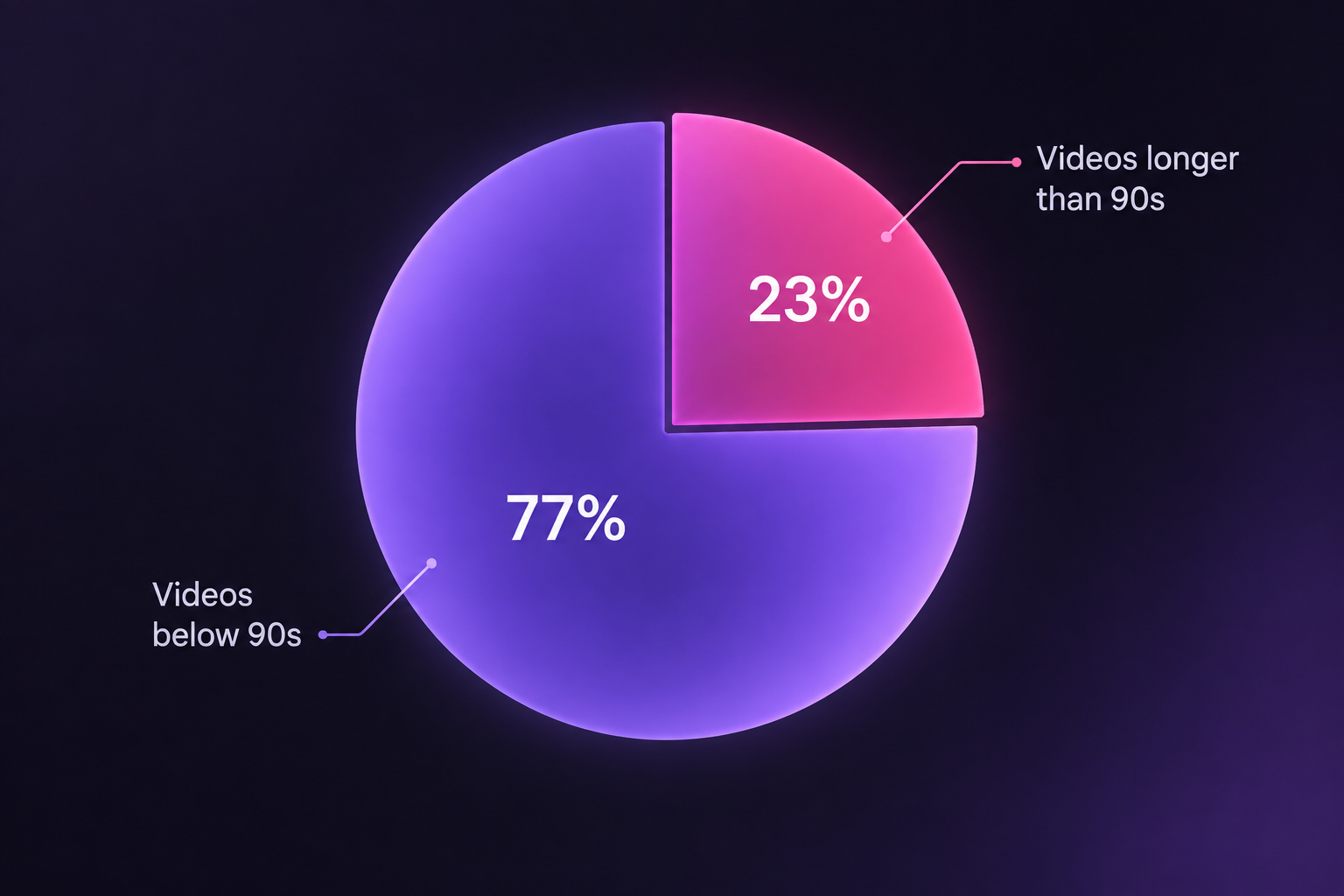
- Average video length: 1:09
- Shortest video: 23 seconds
- Longest video: 4+ minutes
- Only 23% of our product launch videos are longer than 90 seconds
Within this range, we saw a healthy mix of voiceover and non-voiceover videos, and interestingly, that choice didn’t significantly affect length. Whether a video used VO or not, most projects still landed around the same time range.
A few things are worth calling out here. Most launch videos naturally cluster around the one-minute mark, not because of a strict rule, but because that’s often enough time to make the product click without over-explaining. Longer videos tend to appear when the product is more complex or when a deeper explanation is genuinely needed, while shorter ones work well when the message is very focused.
Industry comparison
So, we realized that we can't rely solely on our own data and past projects as examples; we could be an outlier in this case. So, we asked our content researcher to collect data from over 80 videos from brands we don’t work with. We then analyzed their average video length, as well as the shortest and longest videos in the list.
We should include a bit of a disclaimer here. We aimed to gather as many videos as possible while ensuring they came from a diverse range of industries and company models. That being said, IT and SaaS companies are the ones that use product launch videos the most, which is reflected in the list of videos we gathered.
And this is what we found:
.png)
- Longest video: 2:56
- Shortest video: 0:27
- Average video length: 1:15
- Only 25% of their product videos are longer than 90 seconds
Now, we can see that although the results aren't exactly the same, both our internal project and other video launches show similar consistency regarding the average length, the shortest video, and even the percentage of videos above 90 seconds.
We can now safely say that:
Most teams aim for videos under 90 seconds, using longer formats selectively for demos or deeper consideration.
What style should a launch video use? And how long should it be?
Now that we’ve discussed the types and ideal length for a launch video, we’ve created a simple cheatsheet you can use as a guide for your next product launch video. Feel free to screenshot!
Conclusion
A great product launch video is all about one thing: helping people understand your product quickly and getting them excited enough to keep watching. It’s not about explaining every single feature, but about showing what the product is in a simple, easy-to-grasp way.
By answering three key questions, What is it? Why should I care right now? And what do I do next? right from the start, your video can grab attention and lead to action. The goal is to keep things practical, grounded in real experience, and easy to implement.
From our research and industry insights, we found that short, impactful videos work best. Whether it's a hero video, feature-focused clip, or product demo, the focus should be on delivering value to the viewer without overwhelming them.
We recommend aiming for videos under 90 seconds, with the style and length depending on your product and industry. Our cheatsheet above will help you choose the right style and video length for your next product launch.
Just be mindful of your budget. If you want to learn more about video marketing, including product launch videos, feel free to check out our blog How to Cut Costs on Video Production.
If you're ready to create a launch video that delivers results, we’re here to help. Book a call with us today and let’s bring your product launch to life with the right strategy and execution.
FAQ
How long should a product launch video be?
Most launch videos work best between 30 and 90 seconds.
That range is usually enough to explain the core idea without asking too much from the viewer. Longer videos are typically used for product demos or walkthroughs, where the audience is already interested and looking for deeper explanations.
What makes a product launch video effective?
A strong launch video focuses on clarity and momentum.
Within the first few moments, the viewer should understand what the product is, why it matters, and what they should do next. When those things are clear, the video has done its job.
Do SaaS companies usually work with video marketing agencies?
Often, yes.
Explaining software visually requires a mix of product understanding, storytelling, and motion design, which is why many SaaS teams work with agencies that specialize in product videos.
When should you release a product launch video?
Ideally, the video should go live at the same time as the product announcement.
That might be during a new feature release, a major platform update, a new product launch, or even a rebrand. The key is making sure the video supports the moment when people are first hearing about the product.
What is the difference between a product launch video and an explainer video?
They’re similar, but they serve slightly different purposes.
A product launch video focuses on introducing a product and creating excitement. It’s about making the product click quickly.
An explainer video usually goes deeper into how something works and is often used later in the buyer journey.
In practice, many teams use launch videos first and explainer videos later.
FAQ

Sam Jupp
Sam Jupp is the founder of Motion The Agency, with over 11 years of experience in research and marketing. He specializes in leveraging creative animation and motion design to craft compelling brand narratives and writes insightful content on industry trends.

In just a few questions, get a tailored estimate for your next video project.






Contact Us
Ready to elevate your brand? Contact us for your
Free Custom Video Sample