What is a Sizzle Reel? Definition, Examples, and How They're Made

table of content
TL;DR
- A sizzle reel is a short, fast-paced promotional video that highlights the best moments of a brand or product. It’s about momentum, not full explanation.
- It supports early-to-mid funnel goals like awareness and consideration, helping people remember what you do and want to learn more.
- Unlike a showreel (which showcases work) or an explainer (which focuses on clarity), a sizzle reel is built for impact and first impressions.
- Strong sizzle reels rely on:
- Clear storytelling
- High-impact visuals and animation
- Strong sound design
- Tight pacing
- To make one effective, align on audience and goal first, then keep edits intentional and focused on the strongest moments.
Sizzle Reel
If you have ever seen a fast-paced video packed with a brand’s strongest moments, biggest achievements, product highlights, or campaign footage, there is a good chance you were watching a sizzle reel.
A sizzle reel is a short, high-energy promotional video designed to capture attention quickly by bringing together the most compelling moments from a brand, product, event, or company.
If you want to see more examples, check out our blog “Sizzle Reel Inspiration” for more ideas and references.
Sizzle reels originally came from the film and entertainment world, where they were used to showcase standout work and generate excitement around a project. Today, they are used much more widely, including by SaaS and tech companies for brand awareness, product launches, events, investor pitches, and campaign content.
As Pujita, our Senior Motion Designer, puts it:
A sizzle reel is a short promotional video designed to make a brand or product feel compelling in minutes. It focuses on tight pacing, strong visuals, and clear positioning to spark curiosity. Unlike a demo reel, it sells an idea, not a creator’s portfolio. - Pujita, Senior Motion Designer
Think of a sizzle reel as a montage of your best moments. Our Senior Motion Designer likes to describe it like snapshots of top projects, wins, and growth. Big companies often use them as self-promotion, showing only their standout achievements. Take AskPhil, for example. Their sizzle reel is all about highlighting growth and best moments. Layer in some motion graphics sizzle reel elements and the story pops even more.
Sizzle reels aren’t just flashy videos. They’re engagement powerhouses that grab attention, create curiosity, and leave a lasting impression. They’re perfect for brand awareness, product launches, and investor pitches. If you’re in marketing or tech and want to make your content memorable, stick around. We’ll break down the most common types of sizzle reels and show you exactly how to make a sizzle reel that stands out.
The easiest way to think about one is as a highlight reel of the things you want people to remember most. That might be your product, recent wins, customer results, campaign footage, UI, events, or a combination of them. The goal is not to explain every detail. It is to give people enough to understand what is exciting about you and want to see more.
In this guide, we will look at what sizzle reels are used for, real examples, how they are made, how long they should be, and how we approach them at Motion The Agency. So whether you are deciding if you need one or already planning your next reel, this should give you the full picture.
What is a sizzle reel?
So, what exactly is a sizzle reel? The reason it’s called a sizzle reel is because that “sizzle” suggests something hot, exciting, and full of energy. A sizzle reel is designed to create that same feeling: fast, engaging, and focused on the moments that make a brand, product, or event worth paying attention to.
At its core, a sizzle reel is a promotional montage of your strongest moments, combining short clips, motion graphics, typography, music, and sound design. In our Sizzle Reel Examples & Inspiration blog, we explored just how versatile they can be. They can be used for brand showcases, product launches, event highlights, investor pitches, social media, and plenty more.
What makes a sizzle reel different is that it is not trying to explain everything. Instead, it picks out the most interesting, impressive, or memorable parts and brings them together into one energetic story. The goal is usually to create excitement, build interest, and give people a reason to keep watching or find out more.
Not all sizzle reels are the same either. The content, style, pacing, and purpose will depend on what you are trying to achieve. A product sizzle reel might focus heavily on UI and features, while an event reel may rely more on footage, crowd reactions, and atmosphere. The format stays flexible because the story should always follow what you want the audience to remember.
What is a sizzle reel used for?
Sizzle reels are all about grabbing attention, building excitement, and giving people something they’ll remember. They get to the good stuff quickly, which is exactly why they work so well when you only have a short window to make an impression.
Most sizzle reels are fast-paced and bring together a mix of footage, motion graphics, music, and sound design. They also do not need to follow a traditional beginning, middle, and end. Some are built around a mood, while others use a loose story to connect the strongest moments. That is what makes the format so flexible — you can use it for a product launch, a company intro, an event recap, or pretty much anything where you want to create interest fast.
Jon Mowat makes a similar point in The Video Marketing Handbook, where he talks about keeping marketing videos short, punchy, and visually engaging. The idea is simple: show the strongest parts of the product or brand, keep things moving, and give people a reason to pay attention.
Source: Mowat, Jon. Video Marketing. 2nd ed. Kogan Page, 2021.
Quick picks: Where a sizzle reel works best
Go-to-market (Growth / Launch)
- Product launch teaser for your website and socials
- Landing page hero video above the fold
- Paid social “attention driver” cutdown
Sales enablement (Pipeline)
- Cold outbound opener for email or LinkedIn
- Deck insert for pitch meetings
- Conference booth or event opener loop
Brand + team (Trust)
- “What we do” company snapshot for the homepage
- Recruiting or team culture montage
- Partner co-marketing highlight reel
Sizzle reel examples
To understand what makes a good sizzle reel, it helps to look at sizzle reel examples, particularly from the best brands out there who clearly know what they are doing. Here are some of the biggest brands and examples of their sizzle reels:
Introducing Apple Creator Studio
A common reason companies create sizzle reels is to launch a new product. It gives them a way to introduce what is coming without trying to explain every feature at once.
Apple regularly uses this kind of energetic video around its product launches. The focus is usually on showing the product at its best, creating excitement, and giving people a feel for how it fits into everyday life, rather than forcing too much information into a short video. Take a look at the video above: in less than a minute, you understand what is launching, see a few of the standout features, and still have a reason to want to learn more.
That is really where a product sizzle reel works well: show enough to make the product interesting, but leave enough out that people still want to know more.
Amazon Web Series | Digital Content Creation Sizzle Reel
For this one, pay attention to the music and how closely the montage follows it. Across the software-company sizzle reels we reviewed, the music ranged from around 80–120 BPM, while most of the videos were roughly 40–120 seconds long. Those are observations from the examples we studied rather than hard rules for every sizzle reel.
The AWS reel itself uses around 22 clips, with short pieces of text at the beginning and end. By combining those clips with music and content from its own work, AWS keeps the video moving without making it feel overloaded.
And that is really the thing to notice here. When the music, pacing, and visuals feel connected, the reel stops feeling like a random collection of clips and starts feeling like one complete piece.
AskPhill’s brand sizzle reel
AskPhill was one of our first experiences working on a sizzle reel project, and even years later, it still feels current and engaging. The main goal was to create a brand sizzle reel that reflected the company’s culture while also showing the growth AskPhill had experienced throughout the year.
What makes this one interesting is the way it tells a story without turning into an information dump. Instead of listing every achievement, the reel builds a simple narrative around the company’s progress and uses a mix of 2D animation and live footage to keep the visuals varied and engaging.
It is also a good example of how a sizzle reel can be used beyond a product launch or marketing campaign. In this case, it worked as a yearly recap for brand-building, giving AskPhill a way to look back at its growth while still creating something people would actually want to watch.
How to create an engaging sizzle reel?
As a video marketing agency, we’ve created our fair share of sizzle reels for both clients and ourselves. You can check out our 2026 sizzle reel here:
So, after years of fine-tuning, here’s what we’ve learned:
1. Decide what you want the reel to do
Start with the goal. Are you launching a product, showing company growth, promoting an event, or simply trying to get more people familiar with the brand? Once that is clear, it becomes much easier to decide what should actually make it into the reel.
2. Gather your strongest footage and assets
Pull together the bits that show your brand or product at its best. That could be product UI, campaign footage, customer logos, event clips, screenshots, stats, or existing brand assets.
And do not wait until you need a sizzle reel to start collecting them. Keep capturing useful moments as you go, whether that is footage from events, screen recordings, product updates, campaign work, or behind-the-scenes content. The more good material you already have, the easier it is to build the reel later.
3. Pick one clear message
Even though a sizzle reel moves quickly, it still needs one idea holding everything together. Think about what you want someone to remember after watching it. If you try to squeeze in every feature, result, and message, it can quickly start to feel like an information dump.
4. Start with something strong
Do not save your best bit for later. The first few seconds should give people a reason to keep watching, whether that is a bold statement, a strong visual, an impressive result, or a quick glimpse of the product.
5. Build the montage around the pacing
Once you have your strongest moments, it is about putting them together in a way that feels natural. Some clips might be quick, while others need a little more time to land.
The goal is not to make everything as fast as possible. It is to keep the momentum going.
6. Find the right music and sound
Music does a lot of the heavy lifting in a sizzle reel. It sets the mood, gives the edit its rhythm, and changes how the footage feels. Sound effects can then give key cuts, transitions, and movements a little more impact.
Across the examples in our research, the tracks sat between roughly 80 and 120 BPM, but the right tempo still depends on the feeling you want the video to have.
7. Use motion graphics and typography where they help
Motion graphics and typography can tie completely different assets together or call attention to a key message, result, or feature.
At Motion, we often use Adobe After Effects when a sizzle reel needs typography, motion graphics, or visual effects layered into the edit. But those elements do not need to be everywhere. They should make the reel feel more connected and engaging, not busier.
8. Keep cutting things out
A good sizzle reel is usually about what you leave out as much as what you put in. If a scene repeats something the audience already understands or slows the video down, it probably does not need to stay.
The tighter the reel, the easier it is to keep people interested.
9. Get another pair of eyes on it
Before publishing, get some feedback. When you have spent hours working on an edit, it is surprisingly easy to miss a typo, confusing moment, or section that does not land the way you thought it would.
The research specifically recommends collecting feedback before posting to reduce the chance of releasing something confusing or simply missing the target.
10. Give people somewhere to go next
Once you have their attention, do something with it. That could be sending them to a product page, asking them to book a demo, promoting an event, or simply finishing with a strong brand message.
The reel should leave people with either a clear next step or something worth remembering.
How long should a sizzle reel be?
The simple answer is that sizzle reel should be under 3 minutes, but that is not something you can decide without thinking about your product and brand first.
There is no single length that works for every sizzle reel. Across the examples we reviewed, most were around 40–120 seconds, but where the video will be used matters just as much as the number on the timeline.
Before deciding on the length, ask yourself: where is this video actually going to live? Is it going on social media, your website, inside a pitch, or at an event? Knowing that makes it much easier to work out how quickly you need to get to the point and how much information the audience actually needs.
- Website and social media: For videos designed to grab attention online, we generally recommend keeping the reel under 90 seconds and getting to the strongest moments quickly.
- Pitches and presentations: You still want to hook people early, but the reel can spend a little more time building towards the main message and CTA.
- Events and conferences: From our own experience, there can be more room for a longer edit when the audience is already engaged with the topic. If you use the 2–3 minute recommendation here, I would clearly frame it as Motion’s own guidance rather than a finding from the research, because the researched examples themselves mostly sat within the 40–120 second range.
Our Decision Framework, “What to Choose Checklist”
After reading this blog, you might still be wondering whether you actually need a sizzle reel. Even after understanding what it takes to produce one, the real question is: Is it the right strategic move for your stage of growth?
To make that decision easier, we’ve created a simple Yes / No framework below. Use it to quickly assess whether a sizzle reel fits your current goals, positioning, and marketing maturity.
Tools and Software
You will need the correct tools and software to create your sizzle reel. You might be overwhelmed by the number of tools available out there, so it helps to look at the most popular ones.
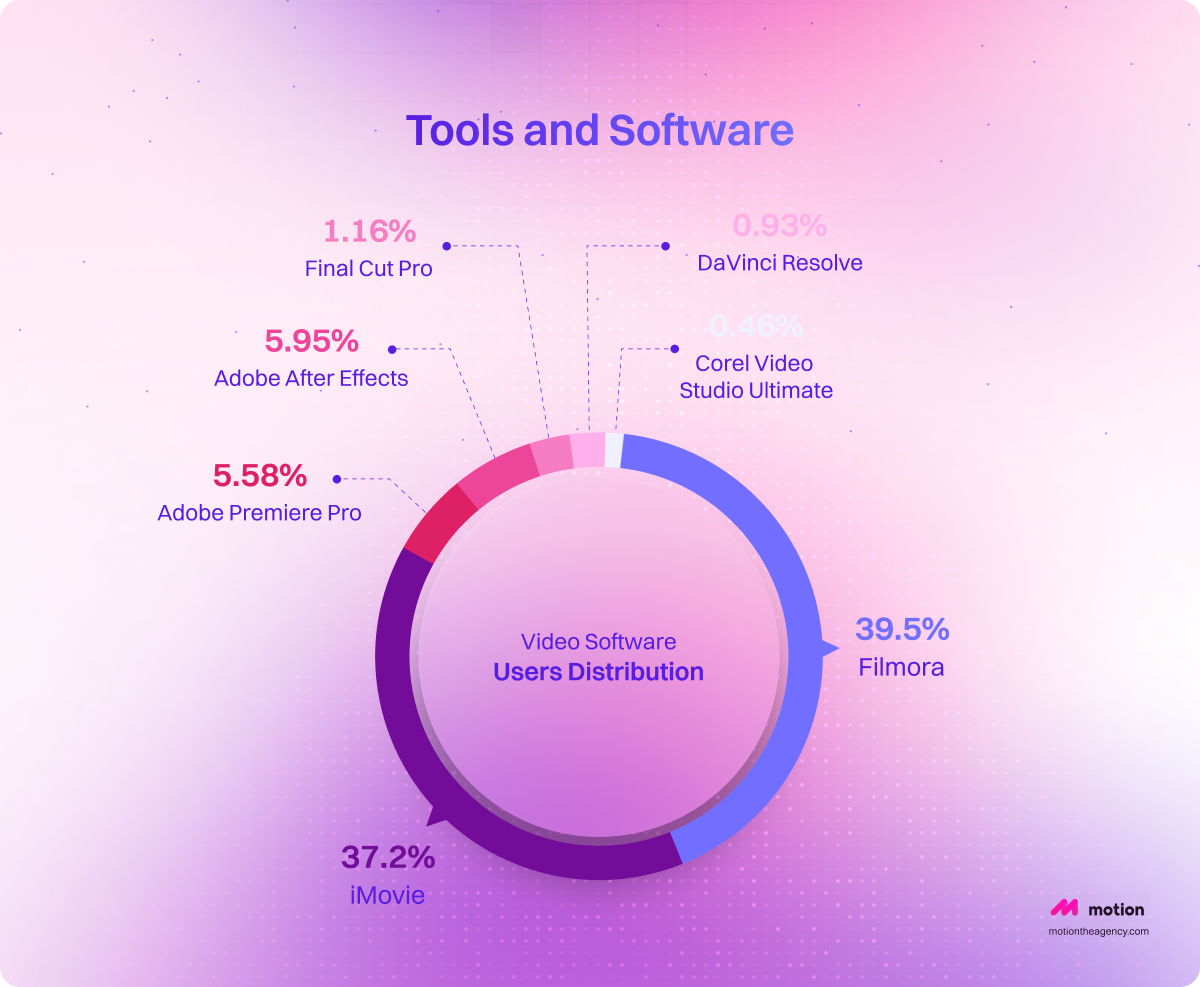
As you can see, Filmora has the most users, followed by iMovie. It helps to look at factors like cost, user features, and usability when deciding which one to use for your sizzle reel.
What’s Next After Sizzle Reel?
As a motion design agency working with many Tech and SaaS clients, we've noticed a common three-step content marketing approach that combines sizzle reels, explainer videos, and product demos.
- Sizzle reels grab attention and create excitement. A well-crafted sizzle reel sparks curiosity and encourages action—often leading viewers to explore more about the brand. Marketers frequently use sizzle reels to drive traffic to their website, where potential customers can dive deeper into what the company has to offer.
- Explainer videos educate and simplify complex ideas. Once an audience is engaged after watching a sizzle reel, they’re more likely to seek out more details about the product or brand. This is where explainer videos shine—offering clear, structured information that breaks down how a product works and what makes it unique. Companies can highlight past projects, customer success stories, or technical capabilities to build credibility and trust.
- Product demos showcase features and drive conversions. After capturing interest and explaining the product’s value, the final step is a detailed, hands-on look at how it works. Product demos provide a walkthrough of features, use cases, and benefits, showing potential customers exactly what they can expect. This is where businesses seal the deal by demonstrating real-world applications and answering the audience’s final questions before making a purchase or commitment.
Together, they create a seamless flow—starting with sizzle reels to grab attention, followed by explainer videos to educate and build interest, and finally, product demos to showcase features and drive conversions. This structured approach keeps your audience engaged at every step, moving them from curiosity to action.
Conclusion
A good sizzle reel does not need to explain everything. It just needs to show the best bits, keep the energy up, and give people a reason to want more.
That is also what makes the format so flexible. You can use a sizzle reel for a product launch, event, pitch, homepage, social campaign, yearly recap, or even just to show how much your company has grown. What really changes is the footage, pacing, length, and message depending on where the video will be used.
So before you start, keep it simple: what do you want people to remember, where will they watch it, and what do you want them to do next? Once you know that, the rest becomes much easier to shape.
If you already have a project in mind but are not sure what to budget for it, take a look at our guide to how much a sizzle reel costs. And if you want to see how we approach them at Motion The Agency, check out our sizzle reel service or get a free sample to see what your own reel could look like.
FAQs About Sizzle Reels

Widi Setyowati
Widi is a content marketing specialist with experience in video marketing, email marketing, and content creation. At Motion The Agency, she specializes in crafting engaging video campaigns, impactful email outreach, and insightful written content.


Sam Jupp
Sam Jupp is the founder of Motion The Agency, with over 11 years of experience in research and marketing. He specializes in leveraging creative animation and motion design to craft compelling brand narratives and writes insightful content on industry trends.

Syarafina Kuswahyuni
Syarafina Kuswahyuni is a content marketer at Motion The Agency, where she covers explainer video production, motion design trends, and video marketing strategy for SaaS brands. She has worked alongside Motion's animation team on projects for clients including ClickUp, Apollo.io, and HackerRank
In just a few questions, get a tailored estimate for your next video project.





Contact Us
Ready to elevate your brand? Contact us for your
Free Custom Video Sample