The SaaS Video Funnel: Awareness, Demo & Retention Strategy
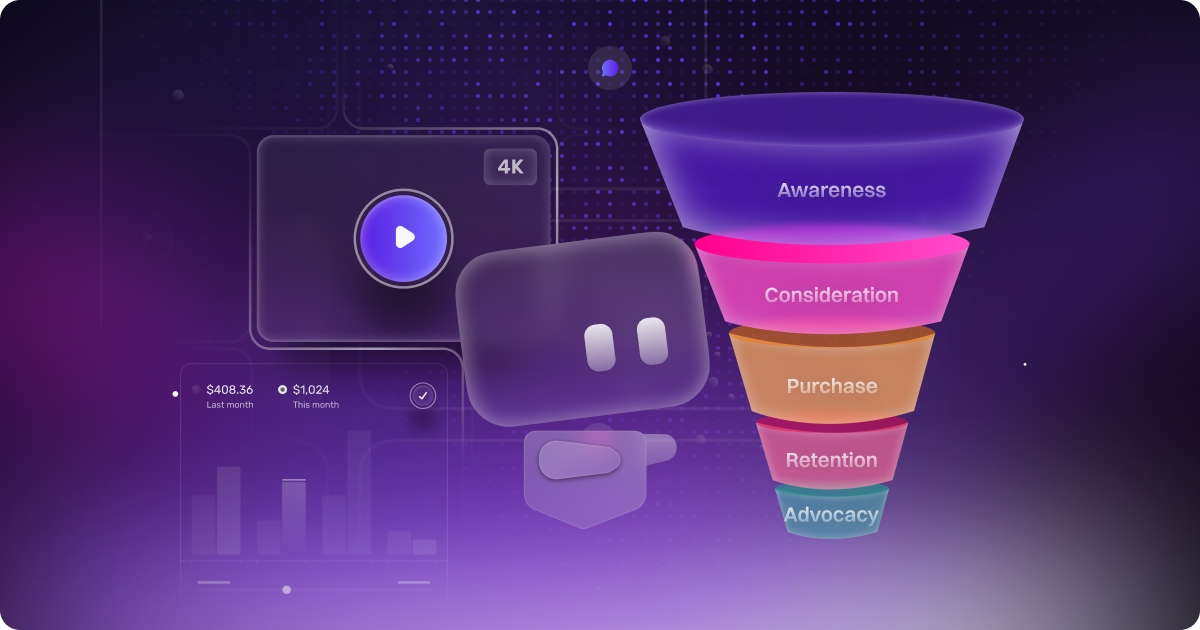
table of content
Key takeaways
- Awareness (Top of Funnel): Frames the problem, not your product Introduces the category without pushing a demo
- Common video types
- Short explainer or concept videos
- Thought-leadership clips
- Paid social videos
- Homepage hero loops
- Common video types
- Consideration (Middle of Funnel): explain how the solution works and why you’re credible. Reduces complexity. Builds proof and confidence
- Common video types
- Product overview videos
- Explainer videos
- “How it works” animations
- Light case-study stories
- Common video types
- Conversion (Bottom of Funnel): Remove objections and push action. Speeds up decision-making. Specific features. Results, proof, and credibility
- Common video types
- Demo videos
- Feature walkthroughs
- Sales enablement videos
- Testimonial videos
- Common video types
What “SaaS video marketing” means
For SaaS companies with complex products, video isn’t just a nice-to-have—it’s a core part of the strategy. It showcases your product, grabs attention, and drives action in ways that text and images simply can’t. In this blog, we’ll dive into how companies are using video across their funnel to engage, educate, and convert at every stage and their strategy.
Okay SaaS video marketing is usually:
- Tied to specific funnel stages
- Built to reduce friction in long buying cycles
- Measured by impact on pipeline, activation, and retention, not just views
Why SaaS video marketing is unlike any other industry
SaaS video marketing is a whole different ballgame. Unlike other industries, it has to tackle some unique challenges. For starters, SaaS products are often complex and intangible, so videos need to break things down, simplify concepts, and educate potential customers before they even think about making a purchase.
Plus, SaaS sales cycles are longer. That means videos aren’t just for conversion. They’re part of an ongoing process to nurture trust and guide prospects through every stage.
Because of this complexity, many SaaS companies work with specialized video marketing agencies that understand how to translate software products into clear, engaging visuals. If you’re exploring options, we recently published a guide on top video marketing agencies to watch in 2026.
Here’s what makes SaaS video marketing different:
- Longer Sales Cycle: SaaS decisions take time, so you need videos for every stage — Awareness, Consideration, and Conversion.
- Complex Products: Videos must explain real problems your software solves, not just features.
- Focus on Education: Prospects need to understand the product before they commit.
- Customer Retention and Expansion: Video also supports onboarding and long-term product adoption.
- Metrics Beyond Views: Success is measured through demo sign-ups, activation, and retention — not just views.
At the end of the day, SaaS video marketing isn’t just about making videos. It’s about guiding prospects through a longer decision-making process while building trust and showing value.
The SaaS video funnel map (what to make at each stage)
Okay, let’s talk about the funnelling. Although, we mentioned that for SaaS need video on each of their funnel. it does not mean it is the same video through out the funnel. in this section we will talked about different types of videos on each section
Awareness (problem + category education)
In the Awareness stage of SaaS video marketing, the goal is to highlight the problem your product solves, without immediately selling the solution. It's about educating your audience on the pain point and introducing your category, building recognition and trust. Videos at this stage should engage emotionally, show empathy, and set the stage for the solution, but not push for a sale. Types of videos for Awareness:
- Teaser/Brand Awareness Videos: Short, emotional stories introducing your brand and category.
- Explainer Videos (Focused on the Problem): Videos explaining why the problem exists and its impact, without diving into the solution.
- Homepage Hero or Loop Videos: Quick, engaging videos that capture attention by focusing on the problem.
- Short Thought-Leadership Clips: Industry insights or trends that highlight the problem without selling.
Consideration (how it works + proof)
In the Consideration stage, SaaS video marketing focuses on helping buyers understand how the solution works and why it’s credible. This stage is about building confidence by explaining the product’s features and showcasing proof of its effectiveness. Videos should simplify complex workflows and provide clear, relatable examples to help prospects visualize how your solution can solve their problem.
Types of videos for Consideration:
- Product Overview Videos: High-level introductions to the product’s features and benefits.
- Case Study Videos: Show real-life examples of customers who have successfully used the product.
- General Walkthroughs: Visual walkthroughs of the product’s capabilities, making complex processes easy to understand.
Conversion (demo + objection-killers)
In the Conversion stage, SaaS video marketing focuses on removing objections and supporting decision-making to encourage prospects to take action. Videos should address common questions, showcase the product’s value, and provide proof to overcome any hesitations. This stage is all about building confidence, showing clear results, and pushing for the final step in the buyer's journey.
Types of videos for Conversion:
- Demo Videos: Show the product in action, highlighting its key features and benefits.
- Testimonial Videos: Real customer stories offering proof and validation of the product’s effectiveness.
- Feature Specific Walkthroughs: Provide an in-depth look at specific features to demonstrate value.
Retention (onboarding + upsell)
In the Retention stage, SaaS video marketing focuses on helping customers get the most value from the product and stay engaged over time. The goal is to support product adoption, reduce churn, and increase lifetime value (LTV) by continuously educating and guiding users. Videos should help customers unlock more features, troubleshoot common issues, and keep them engaged with the product long after the initial sale.
Types of videos for Retention:
- Onboarding Videos: Help new users get started and quickly see value in the product.
- Customer Success Stories: Highlight how other customers are using the product to show additional ways it can add value.
- Upsell Videos: Highlight premium features or plans to show users the additional value they can unlock with an upgrade.
So, what are the metrics being used?
In SaaS video marketing, success is measured by more than just views. To understand the real impact, focus on metrics across the entire funnel. From awareness to retention, these key performance indicators (KPIs) show how your videos move prospects through their journey and ultimately drive business growth.
At the Awareness stage, your goal is to grab attention. Metrics like interaction, impressions, and reach help measure how far your video is spreading and how much buzz it’s generating. While these metrics don’t directly lead to conversions, they lay the groundwork for future engagement.
- Interactions: Likes, comments, shares.
- Impressions: Times the video was shown.
- Reach: Unique viewers who saw your video.
As prospects move into Consideration, focus on average watch time, completion rate, and return visits. These metrics show how engaged viewers are and whether they’re returning to explore more of your content, which typically signals higher buying intent.
- Average Watch Time: How much of your video viewers are watching.
- Completion Rate: Percentage of viewers who watch the entire video.
- Return Visits: Whether viewers come back for more content.
At the Conversion stage, track demo bookings, conversion rates, and assisted attribution to understand how videos are helping move prospects closer to making a purchase. Videos often assist in decision-making and can drive higher conversion rates, especially on pages with video compared to those without.
- Demo Book: How many sign up for a demo after watching.
- Conversion Rate: Percentage of conversions with video vs. without.
- Assisted Attribution: Role video plays in conversions, even if it’s not the last click.
Lastly, SaaS-specific metrics like churn, retention rate, LTV, and CAC measure the long-term success of your video content. Great video marketing not only helps convert leads but also keeps them engaged, reduces churn, and boosts customer lifetime value.
- Churn Rate: Percentage of customers who cancel.
- Retention Rate: How well you keep customers.
- LTV: Total revenue from a customer over time.
- CAC: Cost to acquire a customer.
When to use an agency vs in-house
As an agency operating on a subscription model, we’ve explored this topic in depth in our blog, “Hiring Designers: Should You Go In-House or Try a Design Subscription?” If you’re weighing the pros and cons between building an in-house team or working with a subscription-based agency, that article breaks it down in detail.
In this section, we’ll keep it practical. Instead of going deep into theory, we’ll give you a simple checklist so you know exactly what to expect from both options.
Choosing between an agency or in-house design depends on your team’s needs and project type. Agencies offer flexible, on-demand support with quick turnarounds and predictable pricing, making them ideal for short-term, high-paced tasks like MVPs or startups. They’re perfect if you need scalable design without the overhead of a full-time hire. In-house design, on the other hand, provides deep integration and full control over design direction, making it suitable for long-term, high-complexity projects that require close collaboration and ongoing strategy. While in-house teams may have higher costs, they’re better suited for large-scale projects where consistency and real-time feedback are essential.
Interested in the flexibility of a design subscription? Check out our Design Subscription Page to learn more about how our model can help scale your design efforts.
Conclusion
In SaaS video marketing, the key to success is guiding prospects through each stage of the funnel—Awareness, Consideration, and Conversion—with targeted, engaging content. From introducing the problem in the Awareness stage to simplifying your solution in Consideration, and removing objections in Conversion, video plays a crucial role in moving prospects closer to making a decision. Additionally, focusing on retention and expansion ensures long-term value, fostering ongoing relationships with customers.
Ready to take your video marketing strategy to the next level? Book a call with our team to discuss how we can help you craft videos that drive growth at every stage of your funnel. Book a Call.
FAQ

Syarafina Kuswahyuni
Syarafina Kuswahyuni is a content marketer at Motion The Agency, where she covers explainer video production, motion design trends, and video marketing strategy for SaaS brands. She has worked alongside Motion's animation team on projects for clients including ClickUp, Apollo.io, and HackerRank

In just a few questions, get a tailored estimate for your next video project.





Contact Us
Ready to elevate your brand? Contact us for your
Free Custom Video Sample