How Monday.com Scaled with B2B Video Marketing: A Case Study

table of content
Key takeaways
- Great B2B video marketing isn’t about one high-performing ad. It’s about building a structured, repeatable system that supports the entire buyer journey.
- TOFU, MOFU, and BOFU require different creative thinking.
- At TOFU, you dominate attention.
- At MOFU, you reduce friction.
- At BOFU, you build confidence and retention.
- Creative consistency builds brand recall. But messaging must evolve as the business grows. What works at an early-stage scale won’t always work at enterprises level.
- Owned platforms matter. Structuring content around how buyers research products increases impact without increasing spend.
- Video should be treated as a growth engine, not a production task. When strategy leads, and production follows, results compound.
Monday.com Video Marketing Evolution: Analytics and Insights for Growth
At Motion The Agency, we’re not here just to make videos. We’re here to create videos that actually work. As our clients grew, their needs evolved. They stopped asking for “a video” and started asking how video could drive real business results.
That shift pushed us to study systems, not just creative.
.png)
Arguably, Monday.com has executed one of the most aggressive and sustained B2B video marketing strategies in recent years. Not because of one viral ad, but because they built a structured, repeatable engine.
In this breakdown, we’re unpacking how their video strategy works and what you can apply to your own marketing.
Here’s what you’ll take away:
- The structure behind Monday.com’s video ecosystem
- How to turn ideas into a repeatable video system
- What to create at each stage of the funnel
- Which formats are actually driving attention and scale
Before we dive in, a quick note. Monday.com is a public company, so revenue and marketing data referenced here comes from publicly available reports. Where internal metrics aren’t accessible, we’re analyzing visible patterns across their content and paid ecosystem.
To keep this objective, we:
- Watched over 100 of their top-performing videos
- Reviewed annual reports from 2021 onward
- Analyzed their paid ads using Google Ads Transparency
Video appears across their entire buyer journey, from first impression to enterprise conversion and product education.
Let’s break down how it all connects
Building the brand foundation
Before we talk about scale, we need to talk about foundation.
Back in 2021, there was a clear inflection point. Monday reportedly spent close to 95 percent of their revenue on sales and marketing, with a significant portion driven by video. But the strategy didn’t start there.
The real foundation was built earlier.
In 2017, monday.com rebranded from “daPulse” to simply “monday” with a lowercase “m.” It sounds small, but it was strategic:
- Instantly memorable
- Emotionally relatable
- Built for recall
Around the same time, they internalized a key truth: you don’t have minutes to grab attention. You have seconds.
That insight shaped their entire creative philosophy.
They built a strong in-house video team and anchored their approach around one core principle:
Be bold. Be visible. Dominate attention.
Even as a B2B company, they stopped marketing to “companies” and started marketing to people inside those companies.
And from that point on, video wasn’t just a channel.
It became the engine.
The video strategy that scaled — and then evolved
Now this is where we talk about the real-life application of Monday’s video marketing strategy.
Since 2021, Monday’s revenue has reportedly quadrupled, and video played a core role in that growth. But here’s the important part: the strategy that got them there didn’t stay the same. It evolved.
At the end of the day, Monday is still a business. The goal is revenue growth. Every dollar spent on marketing needs to generate a return.
In the early stages, they leaned heavily into mass reach. Big, flashy paid campaigns designed for visibility and brand dominance. The objective was simple: get attention at scale.
And it worked.
Until it didn’t.
As the company grew, that same broad, high-spend strategy started delivering diminishing returns. There could be several reasons for this. Their core audience may have matured. Media consumption habits may have shifted. Or their buyers may no longer respond to the same type of mass-market messaging.
What worked for brand awareness wasn’t necessarily optimized for enterprise relevance.
Not to mention that although Monday’s revenue grew, their marketing budget didn’t grow with it at the same rate. Which means they had to get smarter — same results, tighter relative resources. The original playbook stopped delivering the same ROI.
So they had to pivot.
They moved away from broad mass-PR campaigns toward targeted enterprise personnels. The positioning shifted from 'hey, look at this cool tool' to 'this is the best infrastructure for your business.' That's a completely different value proposition, and it required completely different creativity.
They also doubled down on owned media — their social channels, their website, their own platform. Instead of just renting attention from ad networks, they started building it. And through all of this? They never abandoned the “hook within seconds” rule.
Mapping videos usage across marketing funnel
Okay, as we mention that a lot of what we mentioned on this blog are available for public. but for this section They don't publicly share their full performance data, so what we are going to discuss in this section is based on an analysis of roughly 100 of their YouTube videos. But the patterns are clear.
TOFU
Okay, although we are a firm believer that every case of marketing campaign is different and very much depending on what the product and needs. but we do understand that in general company tends to spend more on this part of the customer journey, as they tend to have a bigger pull of audience here. and it is the same case as Monday.com.
.png)
Monday.com goes all in. his is where they clearly pour the most creative energy, and it shows in the sheer variety of ad formats they deploy. Long-form skippable ads, non-skippable pre-rolls, multi-variant sequenced ads, and even bumper ads.
Across all of these formats, their motion design is exceptional and the creative philosophy is consistent: make something so visually compelling that the viewer doesn’t want to look away. The goal isn’t to explain the product — it’s to make you stop, feel something, and remember the name.
MOFU
In the middle of the funnel, the content gets longer and more explanatory. These are videos that walk you through what Monday.com actually does and why it matters to your business.
One of our favorite examples is their “monday vibe” video. Instead of a traditional product promo, they build out an app live in a do-along format, almost like a podcast you can watch. They bring in a real business owner to talk through their vision while the product is being built around it in real time.
It feels personal in a way a polished brand video never could. And that’s exactly the point. At MOFU, you’re not trying to impress anymore. You’re trying to make someone seriously consider.
Another thing Monday.com does extremely well at this stage is platform curation.
.png)
They’ve structured their owned platforms — especially their website and YouTube — in a way that makes information easy to find. On YouTube, for example, their homepage isn’t random. It’s intentional.
You can quickly find:
- Feature-specific demos
- Industry use cases
- Tutorials
- Webinars
They organize their videos into playlists that match different stages of the buyer journey. So their YouTube channel isn’t just a place to upload content. It’s structured to reflect how people actually research products.
If someone is in the middle of the funnel and actively comparing tools, they need fast access to relevant information. Structured, categorized content helps them find what they’re looking for without digging through random uploads.
And that matters. At MOFU, buyers aren’t casually scrolling. They’re evaluating. They want clarity, depth, and proof. Monday.com makes that process simple, reducing friction and moving prospects closer to a decision.
BOFU
.png)
At the bottom of the funnel, everything shifts. Monday.com leans into long-form tutorials, podcasts, and detailed walkthroughs built for buyers who already have intent and just need clarity before committing. This stage isn’t about reach. It’s about proof.
Content like Monday Academy requires login access. That’s intentional. At BOFU, they’re filtering for serious buyers. If someone is willing to:
- Create an account
- Log in to access educational content
- Spend time learning the product
that’s already a strong buying signal.
BOFU also supports expansion and retention. The more users understand the product, the more features they adopt. And the more features they adopt, the harder it is to churn.
Execution matters here. Clean structure builds confidence. But missing details, like no closed captions on a learning platform, introduce friction at the exact moment buyers are deciding. BOFU content doesn’t need to be flashy. It needs to feel seamless.
So, what video is actually doing the heavy lifting
So what’s actually performing?
Without internal data, we can’t confirm exact ROI drivers. But based on visible patterns, short product promos with strong motion design seem to be doing most of the work.
These videos are designed for scroll environments, where attention spans are short. They’re fast-paced, visually sharp, and feature clear messaging with strong hooks, grabbing attention even without sound.
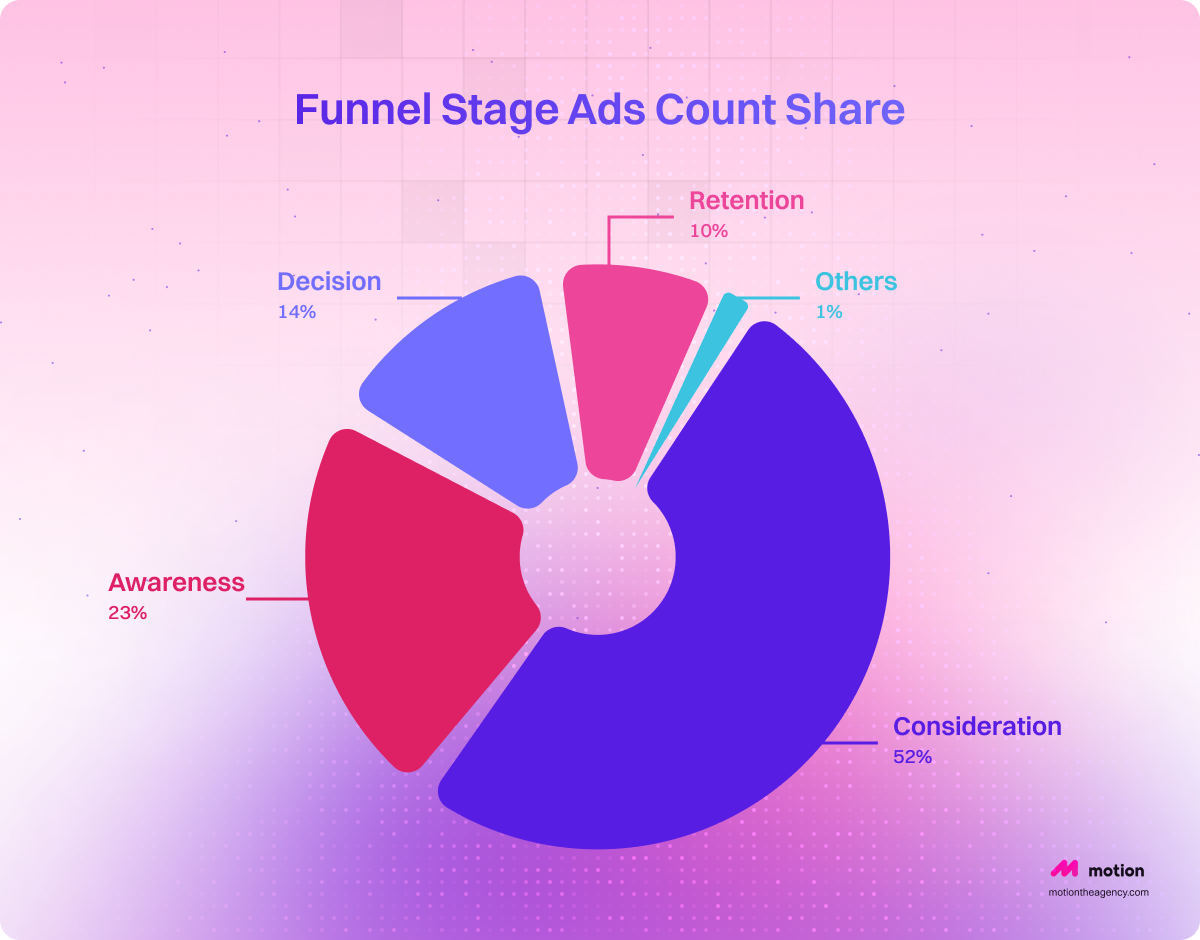
What’s interesting is this: although Monday.com invests heavily in MOFU-style placements and structured evaluation content, the raw view counts consistently skew toward awareness-driven and TOFU campaigns. You can see this in the graph below. It shows that the core promise or what they’re promoting drives the most views, rather than focusing on a specific feature, which is typically found in MOFU and BOFU content. The highest view counts come from “work simplification,” a broad and general message often found at the TOFU stage.
.avif)
In other words, they may be spending strategically across the funnel, but attention still concentrates at the top.
That makes sense.
TOFU is built for scale. It’s optimized for reach, recall, and repetition. MOFU content supports evaluation, but it rarely wins on volume. Its job isn’t mass attention. It’s qualification.
Early on, “marketing to people, not companies” meant going broad. One strong creative. Maximum reach. Speak to everyone.
But that approach has evolved.
Take their Monday Sidekick AI campaign. The core creative stays the same. Same motion. Same style. Same energy. What changes is the framing.
- “Meet the best AI for operations teams.”
- “Meet the best AI for finance teams.”
- “Meet the best AI for decision makers.”
Same creative system. Different audience lens.
Broad reach built the brand. Now, focused relevance drives intent. Instead of shouting to everyone, they’re speaking directly to specific roles.
It’s not a new creative strategy.
It’s a smarter one.
What B2B companies tend to get wrong
Making TOFU videos and expecting BOFU outcomes
A lot of teams create top-of-funnel (TOFU) videos, like awareness or educational content, and expect them to drive bottom-of-funnel (BOFU) results, such as conversions or sales. But here’s the thing: TOFU videos are meant to grab attention, raise awareness, and explain the problem, not close the deal. BOFU videos, on the other hand, should be focused on closing the sale, handling objections, and providing solid proof that your product works. When teams try to use TOFU videos as a conversion tool, they’re missing the point of what each stage should be doing. It’s like trying to use a movie trailer to sell tickets—it just doesn’t work that way!
Measuring Everything with last-click
Relying only on last-click attribution is a huge mistake. Sure, it’s easy to see the last action before someone converts, but it doesn’t show the full story. Most B2B purchases don’t happen in one click—they’re influenced by multiple touchpoints throughout the journey. A TOFU video might be the first step, helping a prospect discover your brand, but it doesn’t get credit if they convert after watching a BOFU demo video. Instead, you need to track the entire journey and use multi-touch attribution to understand how each video, no matter the funnel stage, helps get the customer to the finish line.
Focusing on one-off campaigns
Too many teams focus on creating one-off campaigns and forget about building a video library that supports the whole customer journey. Sure, a single campaign might generate some results, but it’s the ongoing video content that really pays off. By having a library of videos that speak to each stage of the funnel, you can keep nurturing leads over time. Plus, you can repurpose content across different channels and get more mileage out of each video. It’s about building something sustainable that always has a video ready for prospects, whether they’re just starting to explore your brand or they’re on the verge of buying.
Trying to say everything in every video
Here’s a common trap: creating videos that try to communicate everything in one go. Trying to cover the problem, solution, benefits, and features in one video just confuses your audience. Instead, you need a clear message hierarchy—every video should have one goal. TOFU videos should focus on the problem and education. MOFU videos should explain the solution and provide proof. And BOFU videos need to show the features, results, and include a clear call to action. When you focus each video on one thing, you help your audience understand exactly what they need to know at each stage.
So, what to copy and not to copy from Monday? (Especially if you are B2B company)
When creating a video marketing strategy, focus on building a repeatable video system that supports every stage of the buyer journey (TOFU, MOFU, BOFU). Keep your messaging consistent but evolve it as your business grows. Use your owned platforms like social media and your website to control your narrative. Treat video as a growth engine to drive long-term results. Avoid mixing funnel stages—TOFU videos should raise awareness, while BOFU videos should focus on conversions. Don’t rely on last-click attribution; track the entire customer journey. Lastly, instead of creating one-off campaigns, build a video library that nurtures leads over time and keeps your content focused on one clear goal at each stage.
Conclusion
Monday didn’t scale because of one viral ad.
They scaled because they built a system.
And here’s the principle underneath all of it: growth came from structure, not spikes.
They built:
- A brand identity engineered for recall
- An in-house team obsessed with the first few seconds
- A creative engine that evolved as the business evolved
- A full-funnel video structure supporting awareness, consideration, retention, and expansion
At the top of the funnel, they dominate attention.
In the middle, they reduce friction.
At the bottom, they build confidence and increase lifetime value.
Most B2B brands get this wrong. They chase one big campaign. They measure short-term spikes. They expect one creative to carry the entire funnel.
That’s not how compounding growth works.
When mass reach stopped delivering the same ROI, Monday didn’t panic. They refined the system. Broad visibility built the brand. Role-specific relevance now drives intent.
If you only copy one thing from this breakdown, copy this:
Build a repeatable video infrastructure, not isolated creative hits.
Video is not just a tactic. It’s infrastructure. And when it’s built properly, it moves the business forward.
If you want to see how we apply this kind of funnel-driven thinking in real projects, check out our marketing video projects. And if you’re ready to turn video into a structured growth engine for your brand, book a call with our team. Let’s build something that actually performs.
FAQ

Mujahid Habibie
As SEO Manager, Mujahid leads our search strategy across on page, off page, technical SEO, and AI visibility turning complex insights into clear, scalable growth that strengthens our organic performance.


Syarafina Kuswahyuni
Syarafina Kuswahyuni is a content marketer at Motion The Agency, where she covers explainer video production, motion design trends, and video marketing strategy for SaaS brands. She has worked alongside Motion's animation team on projects for clients including ClickUp, Apollo.io, and HackerRank

Widi Setyowati
Widi is a content marketing specialist with experience in video marketing, email marketing, and content creation. At Motion The Agency, she specializes in crafting engaging video campaigns, impactful email outreach, and insightful written content.

In just a few questions, get a tailored estimate for your next video project.






Contact Us
Ready to elevate your brand? Contact us for your
Free Custom Video Sample