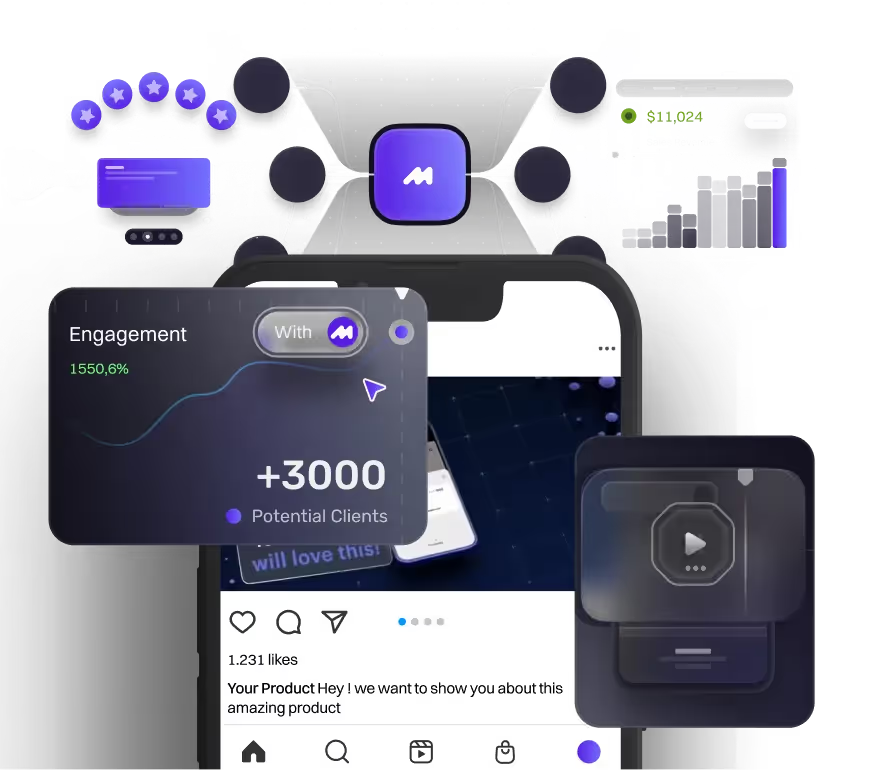
What Makes a Great Product Video? A Guide for SaaS Founders and Marketers

table of content
TL;DR
- A strong product video helps people quickly understand what your product does, how it works, and why it matters.
- It shows the product in action instead of relying only on text or static visuals.
- The right product demo video service can help brands build trust, reduce uncertainty, and make the product value easier to understand.
- A good product video can be repurposed across websites, email campaigns, social media, onboarding flows, and sales materials.
Product video service
Product videos and product video services are one of the most effective ways to build trust and engagement with your audience. They focus on educating users, showing how a product works and why it matters, without pushing a hard sell. This often leads to increased conversions, as 85% of consumers say they’re more likely to purchase after watching a product video.
The key benefits include demonstrating value, triggering mental imagery, and offering content that scales across various channels like social media, email, and product pages. This is also why many businesses use product demo video services to turn product features into clear, engaging videos that support the customer journey.
Why product videos work
Ever seen a video that does not really try to sell you something, but instead just walks you through what the product does and how it works? Chances are, you were not watching a typical ad — you were watching a product video. We talk about real-life applications of product videos in our “How Brands Use Product Videos” blog.
In simple terms, a product video is a short, engaging piece of content that highlights a product’s key features, benefits, and how it works. Funny enough, the main goal is not always to drive sales. Most of the time, product videos are created to educate existing users and help them get more value from what they already have. That said, a good product video often ends up helping with sales anyway, especially when it builds trust and clarity.
Because the focus is on understanding rather than persuasion, product videos tend to skip the hype and marketing fluff you would see in a traditional ad. Instead, they dive into real use cases, product benefits, and practical insights that help viewers truly grasp what the product is about. This is also why working with the right product video production company and other product video services can help turn product knowledge into clear, useful content. It is less about pushing a campaign and more about raising product literacy.
There are a few common types of product videos you’ll see across industries:
- Explainer Video – Breaks down what the product is and why it matters.
- Demo Video – Walks through how it works, step by step.
- Promo Video – Fast, flashy, and designed for launches or announcements.
- How-To/Tutorial – Helps current users get the most out of the product.
- Testimonial Video – Real users sharing real results and experiences.
These formats can be produced in a variety of styles, from live-action shoots to 2D and 3D animation. The format really depends on your brand’s vibe and how complex the product is to show. With product videos playing a growing role in both content and marketing strategies, for physical and digital products alike, it’s worth understanding how they can influence buying decisions and drive long-term engagement.
Let’s dive into that now
Before we dive deeper, let’s talk about why more and more companies are investing in high-quality product videos. One key reason we found while researching this topic is simple: product videos help build trust and engagement, which often leads to long-term support for the product.
Wait, trust? What do you mean by that?
Well, as we mentioned earlier, product videos are not focused on pushing a sale. They are designed to educate, to actually help people understand how a product works and why it matters. And because they are not trying so hard to sell, they tend to come across as more honest, transparent, and helpful. That is why audiences see them as more genuine compared to traditional promotional content. Okay, feel free to check out our YCombinnator case study to see how a lot of early stage SaaS companies build trust with - video
And here’s the thing. 85% of consumers say they are more likely to buy after watching a product video, and in some cases, product videos can boost conversions by up to 80%. So while the main goal might be to educate, the impact often shows up in sales too. This is also why many companies work with a product demo video service to turn product features into clear, engaging, and useful content.
But why exactly is that?
- They show, not just tell: Product videos visually demonstrate how something works. This helps reduce uncertainty and gives people the confidence to make a decision, especially for digital tools or physical products you can’t test out beforehand.
- They trigger mental imagery: A study from Frontiers in Psychology found that using videos helps viewers imagine themselves using the product. That sense of familiarity makes people more likely to take action.
- They match how people consume content: Most people would rather watch than read when researching a product. Mobile users stream over 500 million hours of video every day. No surprise that over 85% of consumers say video makes them more likely to buy.
- They scale across channels: One good product video can do a lot of heavy lifting. You can repurpose it for your website, email campaigns, landing pages, social ads, or onboarding flows. It’s not just a sales tool. It’s a long-term growth asset.
For clients like Apollo.io and HackerRank, we've seen product videos cut down the time it takes prospects to understand core product value, which directly shortens sales cycles.
Product video vs explainer video vs commercial video
To make things easier, we put together a quick table that can help you figure out which type of video is the right fit for your product, audience, and goals.
Types of product video and when to use each
Not every product video has the same job. The format you choose really depends on where your audience is in the buying journey and what they need to understand before taking the next step.
Product demo videos
Product demos are about showing, not just telling. They help potential customers understand what the product does and how it works in a real scenario.
They help viewers understand:
- How the product works
- Key workflows
- Main features
- User experience
Best for:
- SaaS platforms
- Software products
- Tools with multiple features
Testimonial videos
Testimonial videos use real customers to build trust.
Testimonial videos use real customers to build trust and show potential buyers the impact your product has in the real world.
They work well when:
- Buyers already understand the product
- They need proof before making a decision
- Social proof plays an important role
Best for:
- SaaS and B2B products with longer sales cycles
- Companies with strong customer success stories
- Products where trust and credibility influence the buying decision
Product comparison videos
Product comparison videos help buyers understand the differences between solutions and figure out which option makes the most sense for their needs.
The goal is not to attack competitors. It is about clearly showing:
- What makes your product different
- Why your approach works
- Who your product is best suited for
Best for:
- SaaS companies competing in crowded markets
- Products with similar alternatives that need clearer positioning
- Buyers who are already comparing options before making a decision
-
Where should we put a product video?
Alright, so here’s the thing. Unlike promo or ad videos that have a clear home (like paid placements on social media), product videos are a bit more flexible. But that flexibility can be a double-edged sword, where you placed your product video plays a huge role in how well it performs
Here are a few spots that tend to work best:
On product pages (right near the CTA or hero section)
This is where people are usually make a decision. Placing a product video near the product title, price, or main CTA can help answer questions quickly and remove any doubt before someone clicks.
Instead of making visitors scroll through long descriptions or guess how the product works, the video can show the value straight away. It helps people understand the product faster, feel more confident, and take the next step with less friction.
Quick tip: Let it autoplay muted if possible, or use a strong thumbnail with a play button so it grabs attention without being annoying.
Inside email campaigns
Whether it is a welcome email, promo campaign, product update, or win-back flow, adding a video thumbnail can make the email feel more engaging straight away. It gives people a clear reason to click, especially when the video helps explain a product, show a feature, or make the message easier to understand.
This works well because email space is limited. Instead of trying to explain everything in the copy, a short product video can do the heavy lifting after the click. It helps keep the email simple, while still giving your audience a richer way to learn more.
Fun fact: Adding a video to your email can increase click-through rates by up to 300%.
Right in your app or platform (for SaaS tools)
If your product lives online, your video does not always need to sit on a website or social channel. For SaaS tools, placing videos directly inside the platform can help users understand features faster, complete onboarding with less friction, and get value from the product without needing to contact support.
This works especially well for feature walkthroughs, setup guides, product tips, or quick answers to common questions. Instead of making users read a long help article, a short product video can show them exactly what to do, right when they need it.
On social media
People scroll fast, so your product video needs to earn attention quickly. Platforms like Instagram Reels, TikTok, YouTube Shorts, and LinkedIn are great places to share short demos, feature highlights, product tips, or customer stories in a format that feels easy to watch.
The key is to keep it focused. Instead of trying to explain everything, use social videos to show one clear product benefit, answer one common question, or highlight one feature people should care about. That makes the content easier to understand, easier to share, and more useful across different platforms.
We actually talked about social media content and product video more in our case study with GotPhoto, feel free to check it out
Pro move: Keep it short, punchy, and focused on one key point.
Types of product video and when to use each
How to make sure your budgeting works
Like we mentioned in our “Should Your Brand Use Product Videos?” blog, creating a product video isn’t just content — it’s an investment. So if your company is thinking about making one, or working with a product demo video service, you need to be clear on what you’re aiming for and what you actually need.
And yes, budgeting matters too. You’ll want to know upfront how much you’re spending, what you’re getting out of it, and when that ROI might start to show.
So here are some of our tips and suggestions for keeping your budget tight:
- Start with animation or motion graphics: No actors, no shoot days, no locations = lower production costs. You can create slick, high-converting videos using screen recordings, UI mockups, or vector-based animations. Like the example above.
- Repurpose one video in multiple places: One asset, multiple outcomes. Cut your main video into shorter formats.
- Design for modularity: Break your video into clear sections (intro, features, CTA). This lets you swap in new sections later without redoing the whole thing; great for A/B testing or updating features.
- Batch produce multiple variants: Plan ahead. Instead of making one video, create a 60-sec master, a 30-sec social cut, a 15-sec retargeting version, and a vertical version; all in one go. Batching reduces back-and-forth and keeps costs down.
- Work with a creative subscription (like DaaS)Instead of paying per video, consider monthly creative subscriptions. You can visit our subscription page if you want to know more about our subscriptionYou get:
- Fast turnarounds
- Consistent output
- Predictable costs
Want to see what a product video could look like for your brand? We'll create a free custom sample storyboard or short video based on your product. No commitment needed.
A pro move: keep your script aligned with your runtime. A 60-second video needs around 150 words, while a 90-second video needs around 225 words. Keep it focused and let the visuals do the heavy lifting.
Conclusion
So if you’re wondering, “Do product videos actually work?” The answer is yes. Just not in the same way an ad video does. With ads, you might see an instant spike in clicks or sales. But product videos do something else. They help your brand build trust, get people engaged, and make your product easier to understand. That’s where the real value comes in. And if someone ends up buying after watching? Even better.
Now look, it’s still an investment. If you don’t set clear goals or know what you actually need, it might feel like it’s not working. But when you do it right, it can seriously pay off.
Thinking about making one? Make sure it has a purpose, tells the right story, and lives in the right place. And if you want help bringing it to life, we’ve got you.
Book a call or check out our Product Video Services to see how we can help you do it right.

Syarafina Kuswahyuni
Syarafina Kuswahyuni is a content marketer at Motion The Agency, where she covers explainer video production, motion design trends, and video marketing strategy for SaaS brands. She has worked alongside Motion's animation team on projects for clients including ClickUp, Apollo.io, and HackerRank

In just a few questions, get a tailored estimate for your next video project.






Contact Us
Ready to elevate your brand? Contact us for your
Free Custom Video Sample